Quote:
Originally Posted by johnrobholmes

Give the 16awg a shot, it should be a lot easier. Are you using any winding tools? I whittled two chopsticks flat for smashing and pushing the winds in, then I have two flat sticks that keep the winds tight while I move around to the other side. The ends aren't as important as the fill between the slots.
Got any data on the CSA of 5 strands of 22awg? My figure shows .002531153, which is still less than 14awg. Looks like we need to find some 15.5 or 15awg wire.
|
I'm going to be making some winding tools. In practicing, I was using a small screw driver and some needle nose pliers that have teeth in the jaws. That don't work. It's way too easy to create tears in the wire coating.
Something I've noticed about making the decision on just how large the wire can be, We need two wires to lay side by side in the lower valley of the poles. Like the Scorpion 3032 that the Croco guy wound. While reading the website through a German translator, he calls it an 8wd with 1.0mm wire. According to him, This is a 550kv wind, but tests from person to person are inconsistent. This test was probably done with a working load of who knows what.
1mm wire is 18awg. Take a close look at this picture. If too large a wire is used, the bending radius won't be tight enough at the ends either.
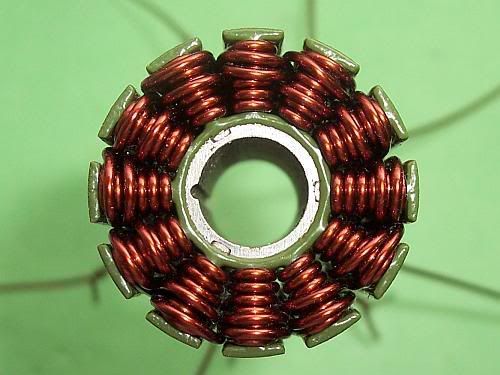
Each size of stator is different with how much of what size wire will fit.
I'm really thinking about getting another AXI 4120 motor to rewind. The more I think about the custom 4130, the more I feel like I'm going to have a motor that is going to draw so many amps, the Quark 125amp Monster Pro won't even be enough on 4S Lipo. Aside from this, trying to figure how many kv it will be is a guess at best, since there isn't a 600kv to 700kv currently on the market to compare this to. I think the amp draw would be out the roof, so would performance, but this is why motor builders move up to High Voltage to get more performance. It's all about keeping the amp draw manageable.
Top speed is great with the 4120/14 on 4S. Being 660kv, it's much easier to come up with a wye wind that will be the same kv and draw close to the same amperage.
"Got any data on the CSA of 5 strands of 22awg? My figure shows .002531153, which is still less than 14awg."
I quickly figured the Single Strand CSA of the current Scorpion offerings for the 3032. Check this out.
3032-8 988kv 27 strand 8 turn 30 awg .0000785 x 27 = Single Strand CSA = .0021195 Total CSA is .0021195 x 8 = .016956
3032-10 823kv 24 strand 10 turn 30 awg .0000785 x 24 = Single Strand CSA = .001884 Total CSA is .001884 x 10 = .01884
3032-12 687kv 20 strand 12 turn 30 awg .0000785 x 20 = Single Strand CSA = .00157 Total CSA is .00157 x 12 = .01884
5 Strands of 22awg is a CSA of .002532253
4 Strands of 22awg is a CSA of .0020258024
It's easy to figure Total Cross Section Area.
Single Strand CSA x Number of turns = Total CSA
The Greater the Total CSA, the higher the amp carrying ability, the more power it will make AND the more efficient the motor will be.
With the 3032, shoot for a Total CSA of .01884 or better.
The German guy's Croco motor wound with 18awg has a Total CSA of .010048
This tells me the Scorpion Factory winds are more efficient and make more power than the Croco motor.
I think I will get some short samples of each awg wire and see how many strands of what will fit the best and work the best according to the figures.
The 4120 winding should be easy enough to convert to a 660kv Wye wind and should tell us what we want to know. I think I'll shoot for that.
