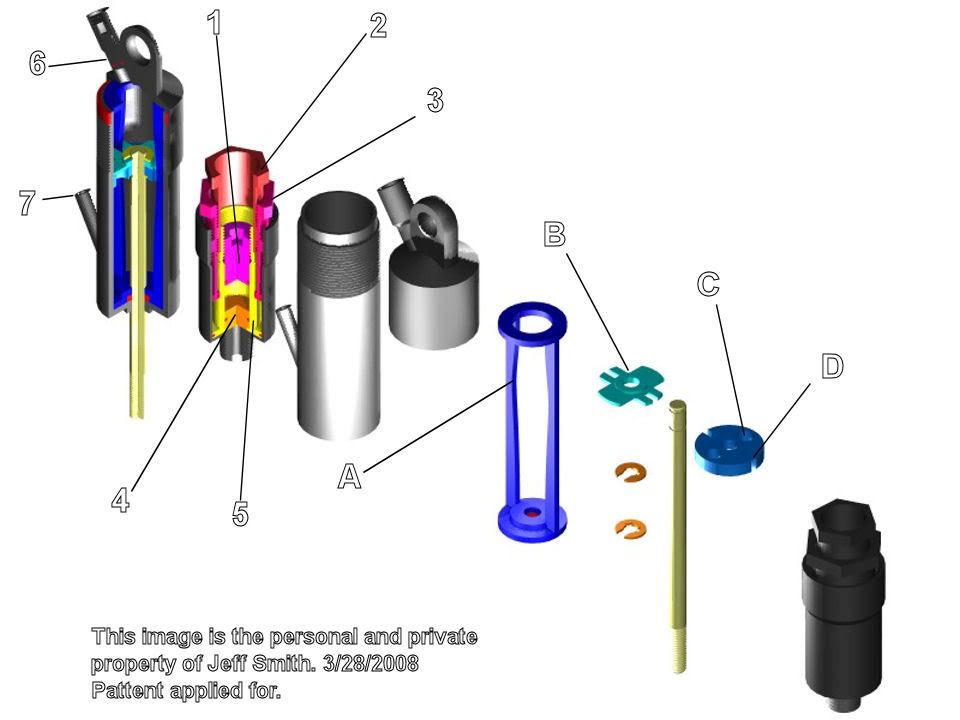
Numbers refer to parts related to the pneumatic spring system incorperated into the design.
Letters refer to valving parts of the design.
1)is the adjustable high pressure apply piston, this adjusts the final portion of shock travel spring rate (top 1/3 roughly as this amount is also adjustable) its volume causes a high rate of increase for a given amount of shock travel.
2)is the piston primary travel stop. It controls how much of the shock travel is controlled by #1 versus #5. Screwing this down makes the shock harder sooner.
3)is the low pressure apply piston, this adjusts the first part of the shock travel spring rate and full extended pre load, it also is the rough adjustment for ride height. It controls roughly the bottom 2/3 of the shock travel as this is adjustable.
4) is the secondary fluid piston it has a preloaded pressure as set by #1, and moves as a unit with #5 until either the
pressure on #5 is greater than the preload, or #5 comes n contact with its stop (#2). It is retained by a machined lip at the bottom of #5 and may only be removed by first removing #1
5)is the primary fluid piston and is moved by the first roughly 2/3 of the shock travel. Its volume causes a low rate of increase as to keep a maximum amount of preload for the full extension of the shock (an amount just below the pressure required for ride height, not tapering off much at full extension).
6) is a fine adjustment for ride height (changes the overall volume inside the shock body), and also serves as a bleed/ fill port (in combination with #7) so the shock fluid may be completley changed without the dissassembly of the shock assembly.
7) is the fitting for attaching a fluid line from the shock body to the air spring assembly.
Valving in the next post...