Quote:
|
Originally Posted by sleebus.jones
Ah. So, this manufacturer is lying on their motor dataplate:
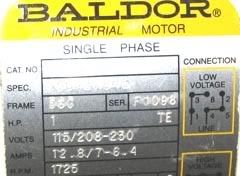
As much as has been argued otherwise, a motor is a constant power device, and the proof is right there in the picture. As voltage goes up, amp draw goes down. If it didn't, then if you ran this motor on 208v, it would magically become a 3.5 HP motor, which is not possible. When you run it on 208v, it draws less power. It's not able to do any more work (which means horsepower, which is equivalent to 746 watts) than it was on 110v, which is exactly why the amp draw goes down. The motor power is set by the design, not the voltage.
Either I'm wrong, or someone changed the laws of Thermodynamics while I was sleeping.
Sleebus |
Sleebus, I can see where you might be coming from with the whole "work" thing, but there are assumptions made which are incorrect.
Motors are not constant power. The power listed on a motor tag will be at the nominal rated voltage. Actually, they usually list this power as "VA" which takes power factor (basically an efficiency factor) into consideration, but I won't go into that. If you double the voltage, you WILL increase current and power by a substantial amount. Maybe not exactly double because of the change in rpm (therefore beack EMF, ie: resistance), but close.
Most dual voltage (120v/240v) AC motors I've seen have alternate sets of windings/connections for the optional voltage; or if three phase, you can hook the windings in wye instead of delta or vice versa. And that's what the little diagram on the right looks like - a way to wire the windings for higher voltage. The motor windings would not like it if you tried to double the current going through them. So, the alternate wiring was designed to increase resistance enough so the power remains the same with higher voltage.
Besides, how could a passive device be constant power? The resistance would have to change. The only way for a device to be a constant power device is if it had active circuitry to read the voltage and be able to adjust its resistance to develop less current to generate equal power.
Ohms law is Ohms law, and it works -
always. It gets a little more complicated than simple Ohm's law for AC motors because you have to take in drive frequency, rpm, and winding inductance (which changes the voltage to current phase angle).