
 |
|
|
|
|
|
 |


 |
My A123 cells are dying... help? |
 |

|
 |

|
(#1)
|
|
RC-Monster Stock
Offline
Posts: 11
Join Date: Sep 2008
|
 My A123 cells are dying... help? -
12.28.2008, 02:03 PM
My A123 cells are dying... help? -
12.28.2008, 02:03 PM
I have an outrunner setup on a HB Lightning buggy. I'm running direct drive to the rear wheels only (no center diff) using a Turnigy 50-55 outrunner, kv=600. Running 6S A123 packs that I build and using a Turnigy 100A ESC.
So I balance the pack and then put it on the buggy. Within about 3 minutes at low throttle with some full throttle blips, the ESC cuts out for low voltage. So I shut it down. The pack comes off usually pretty cold with maybe one or two warm cells. When I check the voltages, it always turns out that only ONE cell is dead. The rest read 3.3 V. My charger won't let me charge that cell now because it has discharged too far. I would say it's just a bad cell, but this has happened to 4 cells individually! Which means I have only had 4 runs on this thing, because every time I run it, a cell dies. Also, everything else I've read about A123s says that they usually maintain excellent balance. Any ideas? Also, just want to throw this out there for others who might be thinking direct-drive with an outrunner is a good idea: On paper, it looks ok, and you can find motors that seem to fit the bill if you use enough cells. My setup, for example, *should* be very hot if I could fix the pack issue. On the track, it would probably be pretty good. But not when bashing. Here's why: consider that these motors are sensorless and so the ESC cannot do a hard, high-torque start from stall like with a brushed motor. The ESC has to roll the motor over a bit to find out where the poles are before apply full torque. This problem is worse on the outrunner because it has no gearing. So if an inrunner setup can apply full torque at say, 2 mph, then the outrunner won't be able to apply full torque until 7 mph (using a common 46/13 spur/pinion ratio). I can see this effect when I hit full throttle with the wheels off of the ground. Even with no load, the outrunner has a bit of a dead spot before it really revs up. So no wheelies from a stop, even with 2WD. So I think my next setup will use the RC-Monster motor mount with an inrunner setup. |
|
|

|
 |
 |
 |
|
|
|
|
|
|
(#2)
|
|
RC-Monster Aluminum

Offline
Posts: 905
Join Date: Aug 2007
|
12.28.2008, 02:38 PM
The ESC is to blame for the low power startups, the turnigy just can't advance the motor fast enough to give good power.
Are they new cells? a123 brand? What is the LVC set to? |
|
|
|
|
|
|
|
|
|
|
|
|
(#3)
|
||
|
RC-Monster Stock
Offline
Posts: 11
Join Date: Sep 2008
|
12.28.2008, 02:49 PM
Quote:
However, I now have a better job, and so I'll be getting the MMM shortly  Quote:
|
||
|
|
|

|
|
|
|
|
|
|
|
|
(#4)
|
|
Old Skool

Offline
Posts: 7,494
Join Date: Feb 2007
Location: Devon, England
|
12.28.2008, 02:50 PM
I was thinking about the lvc setting too- on 99% of escs there are presets for lipo voltages and pack sizes, but A123 cells have a lower nominal voltage (3.4v vs 3.7v), so the lvc would kick in much too soon.
There should be a date of manufacture stamp on the A123 cells, that'll say when they were built, so you can tell how old they are. I know they do very well without balancing, but I have found it is actually important with some chargers, as one cell always hits the peak charge voltage and leaves the others behind, so I have to balance the pack after a charge regardless.. |
|
|
|
|
|
|
|
|
|
|
|
|
(#5)
|
|
RC-Monster Aluminum
Offline
Posts: 905
Join Date: Aug 2007
|
12.28.2008, 02:55 PM
An outrunner may spool up slower as compared to an inrunner (more moment of inertia), but this would be no-load. An outrunner has 7 times the commutation cycles per revolution as compared to a 2 pole inrunner, so the ESC can synch it just as fast as an inrunner hooked to a pinion/ spur geardown.
Has there been any consistency with how the cells die? In a certain spot in the pack maybe? Have you tried slow charging or discharging of the packs to break them in? I have been running a123 a long time and only had once cell out of 50 die. |
|
|
|
|
|
|
|
|
|
|
|
|
(#6)
|
||
|
RC-Monster Stock
Offline
Posts: 11
Join Date: Sep 2008
|
12.28.2008, 04:39 PM
Quote:
Quote:
I have not noticed that they die in a particular location in the pack. The last time this happened, the voltages were 3.3, 3.3, 3.3, 3.3, 3.3, 2.6. Everything I can think of that would cause LVC (bad solder joints, too much current, etc.) should not affect the balance. What about overheating the cells when soldering the tabs? I use a gigantic iron... I think it's 80W, and heat the cell tabs less than 5 secs to tin and then about 5 secs again to solder the wires. |
||
|
|
|
|
|
|
|
|
|
|
|
|
(#7)
|
|
RC-Monster Aluminum
Offline
Posts: 905
Join Date: Aug 2007
|
12.28.2008, 05:09 PM
Back EMF depends on magnet strength, KV, stator construction, air gap, and other factors I am probably not aware of. To generalize, an outrunner gives more feedback EMF because the kv is lower than an inrunner. When you increase the commutation cycles by a factor of 7 (though a higher slot/pole count), generally the construction will allow a reduction of KV by 7 at the same time. Basically the net sum is zero if the inrunner has 7x more geardown as compared to the outrunner.
5 seconds is a lot of time on the cells. That is probably the culprit. You shouldn't be applying heat for more than 2 seconds tops. I get my packs built with one second applications of the iron. Are you using a gun, or an iron? Got a big tip on there? |
|
|
|
|
|
|
|
|
|
|
|
|
(#8)
|
|
Guest
Posts: n/a
|
12.28.2008, 05:17 PM
Wow man, 5sec is a LONG time to have anything hot near the A123 cells lol. You should be using a really hot iron, and literally just touching it on there to solder ie <2sec. They get damaged pretty easily by heat from soldering.
As for the A123s keeping in balance, they do to a certain extent. There's no real point in my experience to slow charge/discharge them. All my packs remain in balance fairly well, unless you discharge lower than like 2.2v/cell, then they go out of balance real quick. Normally, if you just hammer them with high amp charge they normalize and come back into balance near the end of the charge, but only if they're not really too far out of balance to start off with. As I abuse my packs in my vehicles, I've got balance taps on all of them so I can balance charge when needed. For your particular situation, I'd suggest charging each cell up so you're sure they're all individually charged to the same voltage (this is if you don't have balance taps obviously) and then discharge them all together, either on the car, or on a charger. Set the LVC for 2v/cell just to see what happens. If you have a balance adapter you can monitor the cell voltages, and you'll see straight away when the suspect cells begin to dump voltage, which they'll do REALLY quick at somewhere near the bottom of the discharge. If they do that, then once the pack is discharged, when you charge each cell up individually, have a look at how much mAh is put back into each. The broken cells (if they are broken) will take far less that 2300mAh back. Hope that helps -Sid |
|
|
|
|
|
|
|
|
|
|
|
|
(#9)
|
|
|
RC-Monster Brushless
Offline
Posts: 2,085
Join Date: Sep 2007
|
12.28.2008, 05:32 PM
Quote:
I have to disaggree with some things here. Ummm..........it really depends on your setup entirely. 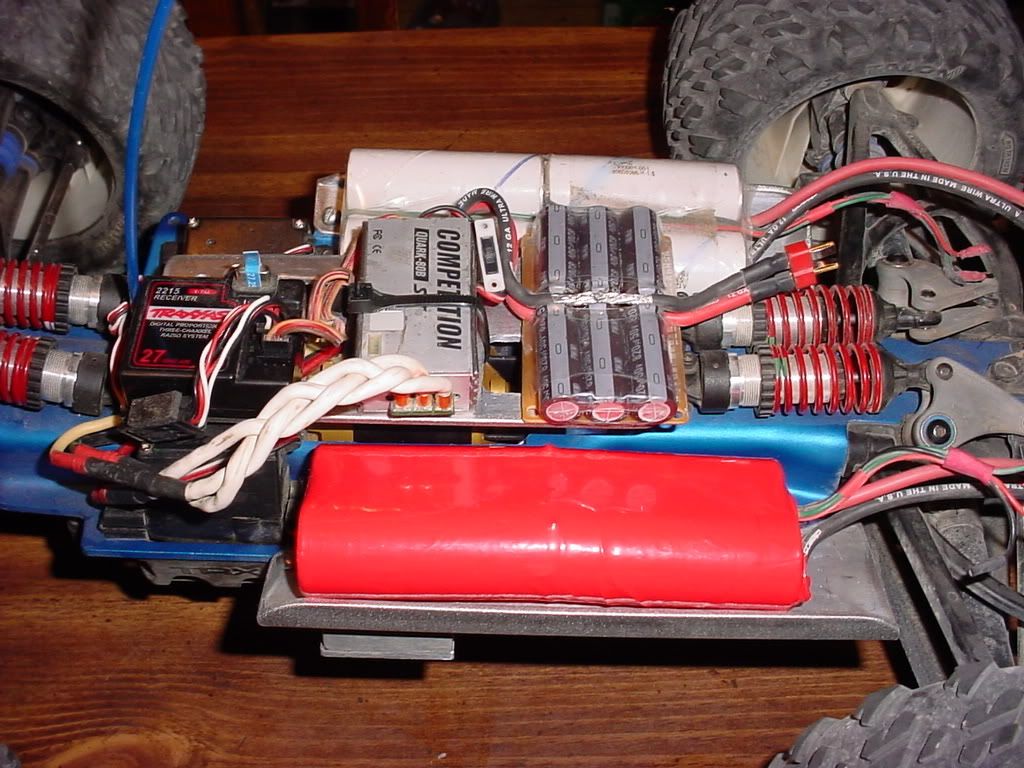 There is an AXI 4130 outrunner under there. 
|
|
|
|
|
|
|
|
|
|
|
|
|
|
(#10)
|
|
|
RC-Monster Stock
Offline
Posts: 11
Join Date: Sep 2008
|
12.28.2008, 07:02 PM
Quote:
Also, with respect to wheelies, they are of course a LOT easier in a truck. I have yet to see an outrunner setup in a buggy that can wheelie, but I have seen it done with inrunners. So are you running 8S? I'm thinking of dropping to 4S, but I need a higher kv outrunner to do that. Right now, I'm pretty limited to the Turnigy stuff because the 8 mm motor shaft fits perfectly in a Hot Bodies drive cup. But I would like to use a higher kv motor with 4S, say 800 or so. With the soldering, I was estimating an upper limit. I am probably in the 2 sec range, but probably not down to 1 sec because I wanted to make sure the flux is burned out. I have the Weller 80 W pencil iron with the big chisel head. Looks like 1/4-3/8" wide. Definitely the correct iron. So have any of you guys ever ruined an A123 by soldering or is this just speculation? |
|
|
|
|
|
|
|
|
|
|
|
|
|
(#11)
|
|
|
RC-Monster Brushless
Offline
Posts: 2,085
Join Date: Sep 2007
|
12.28.2008, 08:11 PM
Quote:
On the Hot Bodies Diff cup, that is what I used on the diff pinion with this setup. The other end of the cvd was 6mm, same as the shaft of the motor. I'm sure you could find some 6mm diff cups that would be compatible if you look around. The right outrunner in your setup will wheelie, and even make it tough to build diffs strong enough to take the abuse. Do alot of research before you buy. Before you settle on things.
|
|
|
|
|
|
|
|
|
|
|
|
|
|
(#12)
|
|
RC-Monster Stock
Offline
Posts: 11
Join Date: Sep 2008
|
12.28.2008, 10:51 PM
I have not found the perfect outrunner for this application, so if you find an outrunner than can do the duty on 4S, I'd be happy to hear about it. Mine is 600 kv, and so by the numbers it *should* be great. But it's not. Plus, 6S A123 packs are quite heavy for a 1/8 buggy. So I need kv = 800 or so for 4S, and motors that size are hard to find.
Another option is to get a Turnigy 50-65 400 kv motor (fits my mount and has the 8 mm shaft) and re-wind it to 800 kv. Stall torque is independent of turns, so even without a re-wind, that motor should accelerate well with a possibly limited top-end. |
|
|
|
|
|
|
|
|
|
|
|
|
(#13)
|
|
Check out my huge box!

Offline
Posts: 11,935
Join Date: Aug 2007
Location: Slidell, LA
|
12.28.2008, 11:05 PM
I would try an new esc with your current setup...MMM? Honestly you need more than 6s1p a123, maybe 2p of those cells, or go to 6s lipo, something decent like flightpower or neuenergy.
Less voltage will only drive the amp draw up, and require a custom motor... More voltage is the way to go, within reason. |
|
|
|
|
|
|
|
|
|
|
|
|
(#14)
|
|
Check out my huge box!
Offline
Posts: 11,935
Join Date: Aug 2007
Location: Slidell, LA
|
12.28.2008, 11:12 PM
Ok, looking back at your problem... Not sure why the cells are dying, where did you get them?
Also that esc is poor, but a MMM and run 5s lipo with your current motor, or go up to 6s lipo and drop down to a 520kv motor. Either way you get to buy some stuff... Some 30c flightpower cells would be nice, like the 3200mah packs for 6s. Not sure what the weight difference would be though. |
|
|
|
|
|
|
|
|
|
|
|
|
(#15)
|
|
RC-Monster Aluminum
Offline
Posts: 905
Join Date: Aug 2007
|
12.28.2008, 11:56 PM
I just caught the 6s part of the build. You need at least 2p of those cells to keep voltage under load with that honking motor. This will cause bad acceleration, along with the ESC. I bet you are drawing 80a or more on those little guys.
Different batteries, different ESC, get a handle on the rollout, and then it can work. I would suggest lipo over a123, unless you use them for the short charge times. |
|
|
|
|
|
|
 |
«
Previous Thread
|
Next Thread
»
| Currently Active Users Viewing This Thread: 1 (0 members and 1 guests) | |
 Linear Mode

|
|

Powered by vBulletin® Version 3.8.11
Copyright ©2000 - 2026, vBulletin Solutions Inc.
vBulletin Skin developed by: vBStyles.com
Copyright ©2000 - 2026, vBulletin Solutions Inc.
vBulletin Skin developed by: vBStyles.com
