
 |
|
|
|
|
|
 |


|
|
 |
Is there a way improve the LVC shutdown |
 |

|
 |

|
(#1)
|
|
A Horse's Ass

Offline
Posts: 1,065
Join Date: Oct 2007
Location: Spokane WA
|
Is there a way improve the LVC shutdown -
02.11.2008, 05:55 PM
First off I didn't do a search for this topic to find an answer before asking. Free time has been limited lately. I hope it wasn't just asked. So apoligies up front.
Setup is pretty basic e-revo - HV4.5 - spektrum sr3100 receiver Novak 4 -cell smart stop (12.5 cutoff) connected to the same tabs as the capacitor using (2) 7.4 2s2p lipos maxamps 6000's or truerc 6400's The problem I have noticed with my set is the LVC will shut down the RC when it spikes below the 12.5v. It will stutter when WOT then eventully shut the RC down. It just dawned on me the other day. The batteries when I take them out and test them are around the 7.6 volt readings. That's after a couple of minutes. I will have to test the battery voltage as soon as it shutdowns to check the voltage then. There seems that there is still plenty of runtime left but no WOT (not as much fun). Is there anything that I can do to keep the LVC from not shutting down unless the batteries are below the cut off for more then a couple seconds. Would adding another capacitor or a UBEC help? Connecting the LVC up differently? Thanks for the help. |
|
|

|
 |
 |
 |
|
|
|
|
|
|
(#2)
|
|
Old Skool

Offline
Posts: 7,494
Join Date: Feb 2007
Location: Devon, England
|
02.11.2008, 06:11 PM
I think its an inherant problem with the design of some, if not most LVC devices. As soon you dip below below the cutoff, even for a nano-second, it kicks in and you get that bad stuttering you describe. I dont think you can connect it up anywhere different to get better results, being next to the cap is probably the best place I think, since it provides a nice steady flow of power. Only thing I can suggest is to do what I have done- find an LVC that had horn or warning light which tells you your batteries are dipping below the cutoff point, rather than cutting your power.
|
|
|
|
|
|
|
|
|
|
|
|
|
(#3)
|
|
A Horse's Ass
Offline
Posts: 1,065
Join Date: Oct 2007
Location: Spokane WA
|
02.11.2008, 06:20 PM
Thanks Niel. I got a LVC for a 7.4 of e-bay that had a light and a buzzer. The alarm would go off real early. When I contacted the person he said he the were set up for planes but he could set it up any way I wanted. To not go off until the voltage was below for a longer time or the actual LVC was 6v etc. I think I will try and reach him again and see what he can do for me.
What will an the extra HV cap do? I looked at thread you linked to about installng them but it was like 32 pages long. Do you mind re"cap"ing it for me. Less heat? |
|
|
|
|
|
|
|
|
|
|
|
|
(#4)
|
|
Old Skool
Offline
Posts: 7,494
Join Date: Feb 2007
Location: Devon, England
|
02.11.2008, 06:30 PM
For my HvMaxx, it resulted in a cooler esc yeah, but much more punch too from my cheapo Nimhs, especially towards the end of a run. Before the extra cap, the truck (txt-1 back then) would sound like it was trying to change gear every few seconds- revs up... dumps.... revs up..... dumps.... and so-on. Now with the extra cap the Gmaxx just runs smoothly right up until the last few minutes, when it slows right down and I bring her home as it were. I would definately recommend adding another novak cap to the hvmaxx, just wire it in parallel to the existing one and you'll instantly see and feel the improvement. $6-10 on ebay I have seen them for, bargain.
|
|
|
|
|
|
|
|
|
|
|
|
|
(#5)
|
|
A Horse's Ass
Offline
Posts: 1,065
Join Date: Oct 2007
Location: Spokane WA
|
02.11.2008, 06:41 PM
I'll give that a shot. I got 2 Novak caps from the escs that I sent in for replacement. Cut them off thinking they might be needed someday. No only if I could use the ton off other stuff I kept that I thought might be needed someday. Thanks again for your help Niel.
|
|
|
|
|
|
|
|
|
|
|
|
|
(#6)
|
|
RC-Monster Admin

Offline
Posts: 14,609
Join Date: Nov 2005
Location: Des Moines, IA
|
02.11.2008, 06:49 PM
Without knowing exactly how the Novak LVC functions, you may be able to help with that by using a diode and a small capacitor (and maybe a small resistor) like in the diagram below:
 The capacitor would be a small value, like 0.1uF, and is there to store the voltage. When a high current pulse happens, the battery voltage will drop, but this capacitor will slowly drain and the LVC won't respond as quickly. By the time the cap would reach the cutoff voltage of the LVC, the battery voltage is back up. Basically, just adds a delay. The resistor helps control the rate at which the cap discharges for a faster or slower delay since I have no idea what kind of load the LVC itself presents. The diode will allow current to flow into the LVC to prevent the small cap from trying to supply the ESC (which would totally negate the purpose of this idea). The diode would have to be a low v-drop type like germanium because the LVC will see the battery pack V minus whatever voltage the diode drops. But since the LVC is not as sensitive to voltage sags, it should be fine. |
  |
|
|
|
|
|
|
|
|
|
|
(#7)
|
|
Old Skool
Offline
Posts: 7,494
Join Date: Feb 2007
Location: Devon, England
|
02.11.2008, 07:27 PM
Delayed reaction LVC, I like it alot. How long before manufacturers start introducing these as a normal item, it makes alot of sense when you concider the load some systems can put on a lesser lipo...
|
|
|
|
|
|
|
|
|
|
|
|
|
(#8)
|
|
RC-Monster Admin
Offline
Posts: 14,609
Join Date: Nov 2005
Location: Des Moines, IA
|
02.11.2008, 07:48 PM
I don't know why they don't have it already. Seems easy to do. The only thing about the arrangement I posted above is that instead of a 4s pack cutting off at 12v (3.0v/cell), it will cut off at 12.7v (3.175v/cell) for a 0.7v drop silicon diode, or 12.3v (3.075v/cell) for a 0.3v drop germanium diode. Anything lower than a 4s LVC wouldn't work well since the diode voltage drop would be too great.
The nice thing about this "circuit" is that it can be contained on a small heatshrink-wrapped PCB with in/out wires (like a UBEC) and can even add a small PCB mount potentiometer to adjust the delay at which the LVC responds. I'd try it but I don't have a test LVC to play with. The only other way to make sure the voltage doesn't drop under quick heavy loads is to add a bunch of low-esr caps to help with the surges. It would be larger and more expensive, not to mention the initial hook-up spark due to the large capacitance you'd have to have. |
|
|
|
|
|
|
|
|
|
|
|
|
(#9)
|
|
|
A Horse's Ass
Offline
Posts: 1,065
Join Date: Oct 2007
Location: Spokane WA
|
02.15.2008, 03:02 AM
Quote:
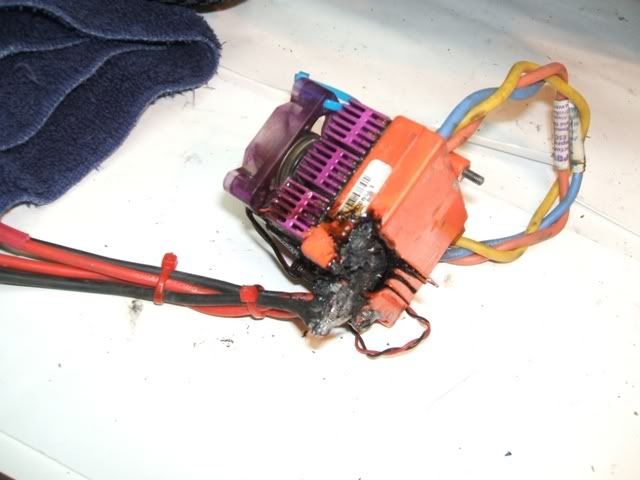 Now I need to get a hold of Mike. Ten minutes before this happened I ordered the Gorilla Maxx tranny conversion and the other half of the FLM tranny case from him. I am hoping he will let me cancel that order so I can order a MGM controller and Neu motor. It doesn't look like he has many Nue's in stock though. |
|
|
|
|

|
|
|
|
|
|
|
|
|
(#10)
|
|
That's All Folks!

Offline
Posts: 2,359
Join Date: Dec 2006
Location: in a VAN down by the RIVER
|
02.11.2008, 11:33 PM
Perhaps a delayed LVC is not a good idea. If it allows the batteries to drop below 3v a cell, even for a split second, it may be enough to do damage to the batteries (or at least shorten their life considerably).
|
|
|
|
|
|
|
|
|
|
|
|
|
(#11)
|
|
|
RC-Monster Admin
Offline
Posts: 14,609
Join Date: Nov 2005
Location: Des Moines, IA
|
02.12.2008, 06:37 PM
Quote:
Even so, this would just prevent the LVC from reacting too quickly. Bursts usually last a couple mS, so all you need to do is average the voltage out so it doesn't dip at the LVC at quite the same speed as at the ESC. Basically, make it have around a 1/5 to 1/4 second delay. Is it perfect? No. Then again, it is a simple and cheap alternative. 
|
|
|
|
|
|
|
|
|
|
|
|
|
|
(#12)
|
|
|
RC-Monster Mod

Offline
Posts: 4,217
Join Date: Apr 2006
Location: Chicago, IL
|
02.12.2008, 08:11 PM
Quote:
I say this with the exception of the MGM controllers which just flat out have much to sensative of a LVC. to make it... or break it... Silent...But Deadly |
|
|
|
|
|
|
|
|
|
|
|
|
|
(#13)
|
|
Check out my huge box!

Offline
Posts: 11,935
Join Date: Aug 2007
Location: Slidell, LA
|
02.12.2008, 08:40 PM
I would say that the best cure would be a pair of trakpower lipos. They cured my issues with poor performance on a high draw system. Gearing down slightly may help too.
|
|
|
|
|
|
|
|
|
|
|
|
|
(#14)
|
|
Old Skool
Offline
Posts: 7,494
Join Date: Feb 2007
Location: Devon, England
|
02.12.2008, 06:00 PM
I'd say it depends on how sensitive the lipos are to being over-discharged, but you'd have to go careful, thats for sure. Still, its a clever idea and something very useful for our applications.
|
|
|
|
|
|
|
|
|
|
|
|
|
(#15)
|
|
RC-Monster Admin
Offline
Posts: 14,609
Join Date: Nov 2005
Location: Des Moines, IA
|
02.15.2008, 10:39 AM
Well, if you don't mind donating it for wa while, I wouldn't mind trying it out. And for your trouble, you can have the modified circuit (assuming it works as well as I think it will).
Let me know via PM what you want to do and we can make the arrangements. |
|
|
|
|
|
|
 |
«
Previous Thread
|
Next Thread
»
| Currently Active Users Viewing This Thread: 1 (0 members and 1 guests) | |

 Hybrid Mode
|
|

Powered by vBulletin® Version 3.8.11
Copyright ©2000 - 2026, vBulletin Solutions Inc.
vBulletin Skin developed by: vBStyles.com
Copyright ©2000 - 2026, vBulletin Solutions Inc.
vBulletin Skin developed by: vBStyles.com
