
 |
|
|
|
|
|
 |


 |
More machine porn... |
 |

|
 |

|
(#16)
|
|
RC-Monster Titanium

Offline
Posts: 1,697
Join Date: Mar 2008
|
More machine porn... -
12.21.2010, 03:03 PM
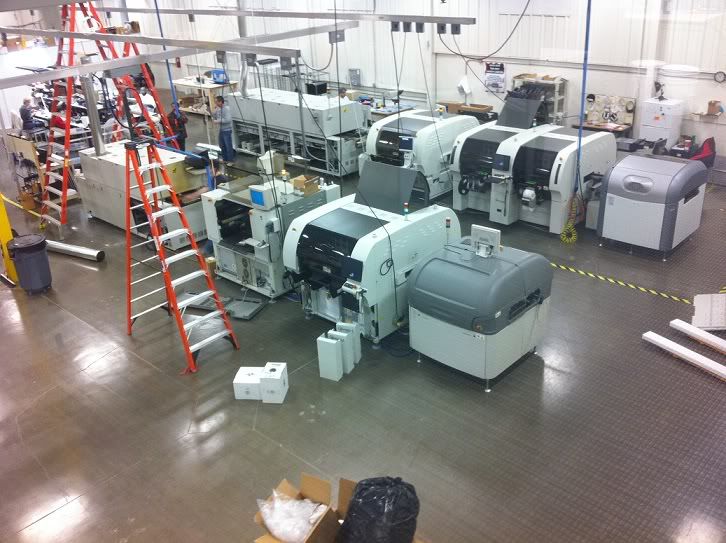
Installation proceeding on the second production line:
President, Principle Engineer Castle Creations |
|
|

|
 |
 |
 |
|
|
|
|
|
|
(#17)
|
|
2 KiloWatt RACER
Offline
Posts: 2,496
Join Date: May 2007
Location: Houston
|
12.21.2010, 03:25 PM
Looking good!!
GTP-Pletty Big Maxximum+RX8. GTP-C50-6L Hacker+RX8. CRT.5-Pro4+ZTW esc. 24s2p EVG SX 49.6mph Ebike. 18s4p Raptor 60mph Ebike. 11.5KW |
|
|
|
|
|
|
|
|
|
|
|
|
(#18)
|
|
RC-Monster Titanium
Offline
Posts: 1,697
Join Date: Mar 2008
|
12.21.2010, 03:27 PM
And here it is with the machines labelled. Note the fast production line is against the wall (with the quad and dual head machines) and the flexible line is closest (with the single head machines.)
The quad head chipshooter is capable of 135,000 parts per hour, the single head chipshooter is capable to about 30,000 parts per hour. The dual head placer can place about 24,000 parts per hour, and the single head placer can do upwards of 16,000 parts per hour. So the line throughput is approx. 160,000 parts per hour on the fast line, and 45,000 parts per hour on the flexible line. Real-world throughput is about half the rated... Pretty sexy stuff...  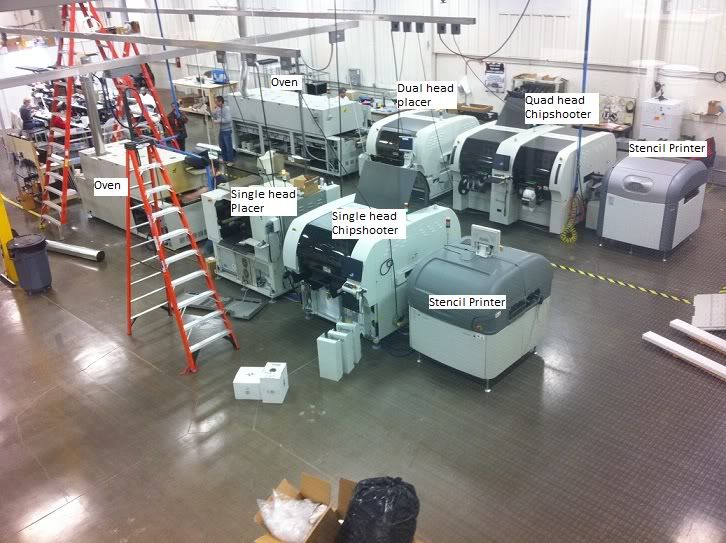
President, Principle Engineer Castle Creations |
|
|
|
|
|
|
|
|
|
|
|
|
(#19)
|
|
RC-Monster Stock
Offline
Posts: 49
Join Date: Jan 2009
|
12.21.2010, 04:28 PM
nice....
And now for the video.... 
|
|
|
|
|
|
|
|
|
|
|
|
|
(#20)
|
|
RC-Monster Carbon Fiber
Offline
Posts: 76
Join Date: Feb 2008
|
12.21.2010, 07:59 PM
Or a how its made show lol
|
|
|
|
|
|
|
|
|
|
|
|
|
(#21)
|
|
Soldermaster Extraordinaire

Offline
Posts: 4,529
Join Date: Apr 2007
Location: Plymouth, MA, USA
|
12.21.2010, 08:11 PM
You know, aside from the things that give that picture scale, it looks like a bunch of toaster ovens and photocopiers sitting on a counter top.
|
|
|
|
|
|
|
|
|
|
|
|
|
(#22)
|
|
RC-Monster Titanium

Offline
Posts: 1,884
Join Date: Jul 2009
|
12.21.2010, 09:30 PM
Pdelcast, is there any way you can give a brief description (in lamen's terms) of what each machine does in the manufacturing process?
I understand what the placer does, but not really sure about the stencil printer and chipshooter. |
|
|
|
|
|
|
|
|
|
|
|
|
(#23)
|
|
|
8th scale Stunt-Driver/Mechanic

Offline
Posts: 441
Join Date: Dec 2008
Location: SoCal
|
12.21.2010, 09:57 PM
Quote:
Patrick, Thanks for Sharing! 
Raja - FLM Ext. MM, 1512, 4s SC8ight - MMM, 1520, 6s D8T - MMM 1717 6s My OVERPOWERED Rides "CLICK" Like Playing Cards? Cut-Throat Rummy "CLICK" |
|
|
|
|

|
|
|
|
|
|
|
|
|
(#24)
|
|
|
RC-Monster Titanium
Offline
Posts: 1,697
Join Date: Mar 2008
|
12.22.2010, 12:36 AM
Quote:
The solder is printed on the board by the stencil printer. The solder comes in a form called "solder paste" (it has about the consistency of toothpaste -- it's made of microscopic solder balls suspended in a liquid flux, and costs about $80.00 a pound.) We have stencils made for the circuit boards from .005" thick stainless steel in a 29"x29" frame. The stencils are cut by laser. Where ever there is an opening in the stencil, the solder is deposited on the circuit board. The job of the stencil printer is consistency -- it aligns the stencils and the circuit boards to within 2 ten thousandths of an inch, squeegees the solder paste onto the circuit board through the stencil, cleans the stencil, checks the paste on the board to make sure the paste coverage is correct without any excess paste, and then sends the board to the chipshooter by conveyor. The Chipshooter is a high speed placement machine that uses a 30 position rotary head. Chipshooters are faster than regular placement machines by about a factor of 2 to 3. BUT, they are limited in the type of components they can place on the board (they can't place really heavy or odd-form components.) We have two chipshooters, one with four heads, and one with just one head (our new machine.) Here's a video of a chipshooter of the same brand as ours. This model has one head. Our new single-head machine is actually FASTER than the machine in this video -- the video shows an older rotary positioning machine (see the big leadscrew above the head? Our machine uses a big linear motor, and accellerates the head faster than this older machine.) http://www.youtube.com/watch?v=oEz4L34ipYA Now imagine our BIG chipshooter -- it has FOUR heads, that all work at the same time... :) After the chipshooter is done placing, (and it places about 95% of the parts on the circuit board) the board moves into the flexible/fine pitch placer. This is a 7 spindle machine with vertical spindles instead of rotary spindles. It can pick and place a wider variety of parts than the chipshooter. So whatever the chipshooter can't handle is placed by the flexible/fine pitch placer. This is similar to our flexible/fine pitch placer: Again, this is an older, slower machine than what we are using. We have one single head machine, and one dual head machine. http://www.youtube.com/watch?v=wJ-vG8WcK7Y Once the board is done in the flexible/fine pitch placer, it moves into the reflow oven, where the temperature is slowly increased as the circuit board moves through the oven, until the solder all melts at one time. Once it comes out of the oven, it gets queued for an AOI (automatic Optical Inspection) machine, where all the solder joints, joint quality, component placement, and component number and value are checked. Then the boards are depanelized (cut apart -- we build anywhere from 20-120 circuit boards in a single panel) and queued for finish assembly, testing, and packaging. That's pretty much how it's made.
President, Principle Engineer Castle Creations |
|
|
|
|
|
|
|
|
Thanks patrick. |
|
|
|
|
|
(#25)
|
|
JERRY2KONE SUPERMAXX

Offline
Posts: 3,452
Join Date: Sep 2006
Location: HAYMARKET VIRGINIA
|
Thanks patrick. -
12.22.2010, 01:06 AM
Thank you Patrick for sharing information with us here on RCM. Never having seen one of these lines and not knowing how all of this is done, seeing your pics and reading your info is a great way for us consumers to see how these top notch products are actually made. Very cool info and it is just great that you can and do share your success with us, since we are your business. I for one really appricate that you are in here sharing info and even helping to resolve some issues for the occasional hobbiest issue. What a great forum. Thank you too Mike.
|
|
|
|
|
|
|
|
|
|
|
|
|
(#26)
|
|
Fat Kid Engineering

Offline
Posts: 3,634
Join Date: Jun 2009
Location: Hot as Hell West Central Coast Florida
|
12.22.2010, 10:03 AM
Awesome stuff, always curious about things of this nature especially about Castle !
Thanks for sharing Patrick. |
|
|
|
|
|
|
|
|
|
|
|
|
(#27)
|
|
|
Guelph, Canada, eh!

Offline
Posts: 1,083
Join Date: Sep 2007
Location: Guelph, Ontario, Canada
|
12.22.2010, 10:35 AM
Quote:
|
|
|
|
|
|
|
|
|
|
|
|
|
|
(#28)
|
|
RC-Monster Aluminum

Offline
Posts: 738
Join Date: Oct 2010
Location: Williston, ND
|
12.22.2010, 04:30 PM
Thanks Patrick :)
|
  |
|
|
|
|
|
|
|
|
|
|
(#29)
|
|
Guest
Posts: n/a
|
12.22.2010, 06:41 PM
Thats totally freaking cool and a bit of a mind job also lol! Makes me proud to own a castle product even if it is rebadged by HPI. I wonder what big ass companies like Traxxas use to make all their brushless systems in bulk?
Im confused by the oven. Isn't the solder already placed by the stencil printer? Is it a special solder that stays in paste like form to install components and then once heated and melts and cools, it turns solid once? How can those delicate circuits survive in that high heat which im guess is like 300+ F? |
|
|
|
|
|
|
|
|
|
|
|
|
(#30)
|
|
|
RC-Monster Aluminum

Offline
Posts: 897
Join Date: Mar 2010
Location: Same town as "Brand P"
|
12.22.2010, 06:53 PM
Quote:
|
|
|
|
|
|
|
|
 |
«
Previous Thread
|
Next Thread
»
| Currently Active Users Viewing This Thread: 1 (0 members and 1 guests) | |
 Linear Mode

|
|

Powered by vBulletin® Version 3.8.11
Copyright ©2000 - 2026, vBulletin Solutions Inc.
vBulletin Skin developed by: vBStyles.com
Copyright ©2000 - 2026, vBulletin Solutions Inc.
vBulletin Skin developed by: vBStyles.com
