
 |
|
|
|
 |


|
|
 |
 |

|
 |

|
(#1)
|
|
RC-Monster Aluminum

Offline
Posts: 768
Join Date: Jul 2009
Location: NJ
|
07.05.2010, 11:45 AM
I've been tuning and testing this and have it where it handles well on dry grass on 8s geared for 50mph. It's still twitchy at high speeds if I punch the throttle (lots of power!) - but it's very controllable. I'll continue to tweak it but I'm happy.
Temps after driving it pretty hard for about 20mins (90F ambient): batts: 114F esc: 132F motor: 160F I also checked my diffs' temps and was surprised to see my center diff was 190F (rear - 145F, front - 130F). I have 25k diff oil in there now - I may have to thicken it up again if the CD temps are a problem. Anyone know how high is too high for silicone diff oil - or diffs in general? I expect the silicone can go much higher than that - it's used for cooking utensils rated for 400F. I've never paid much attention to diff temps before, so I haven't given it much thought. Edit: I'll get vids up later this week or weekend when my wife gets home with the kids and the video camera! |
|
|

|
 |
 |
 |
|
First carnage |
|
|
|
|
|
(#2)
|
|
RC-Monster Aluminum
Offline
Posts: 768
Join Date: Jul 2009
Location: NJ
|
First carnage -
07.06.2010, 06:43 PM
I was driving on some soccer fields, getting it up to full throttle for some speed runs across the field. The grass is very dry and dusty - poor traction. So I was about to finish up, but did a couple more runs, the last of which, I thought I had everything under control, but drifted a little at high speed - into the soccer goal post.
 I was expecting major damage as I saw one wheel + other parts flying in one direction and the rest of it in another. So I was happy to see it was mainly the plastic arms that broke and a bent driveshaft: 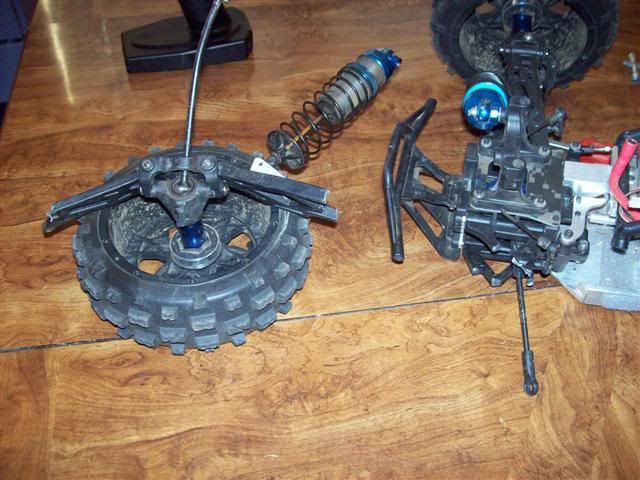 Then I got home and saw the right rear driveshaft  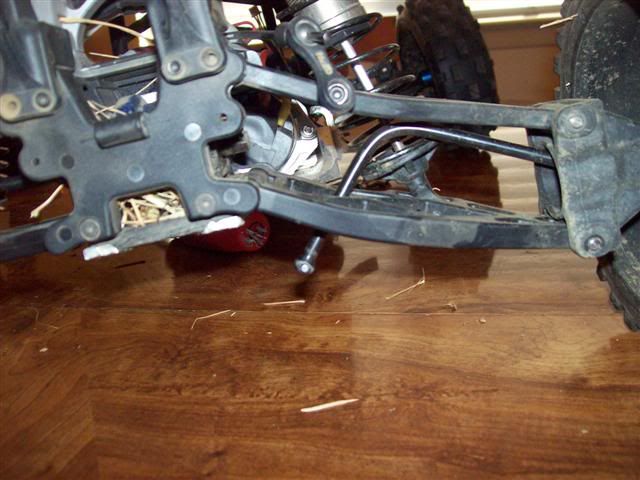 Those arms are bent and need replaced too. Luckily I have a box of extra arms and other parts - I'll have this back together to take it out tomorrow. 
|
|
|
|
|
|
|
|
|
|
|
|
|
(#3)
|
|
RC-Monster Carbon Fiber
Offline
Posts: 170
Join Date: Aug 2008
|
07.06.2010, 07:05 PM
Now that is a trick!! Doesn't all the bad stuff happen on "one more time"? That's the way it goes for me.
-JB |
|
|
|
|
|
|
|
|
|
|
|
|
(#4)
|
|
|
Destroyer of Tires

Offline
Posts: 626
Join Date: Feb 2009
|
07.06.2010, 08:34 PM
Quote:
Blew the rear diff in my e-revo doing "one more" wheely, and the cd in my ofna buggy doing "one more" hard dragster style launch. All this past weekend. Got the parts laying around and a few days before the weekend, so its all good. Good to see the carnage isn't that bad though. I don't think you'll be able to tune out "all" of the on power drifting. Its inherent in shaft vehicles, especially ones with huge power. Thats why the touring cars are all going to belt drive, to get rid of the effect. |
|
|
|
|

|
|
|
|
|
|
|
|
|
(#5)
|
|
RC-Monster Titanium
Offline
Posts: 1,007
Join Date: Apr 2010
|
07.07.2010, 04:40 AM
ouch... at least its minor damage. How that happend to the shaft iscrazy!!!
overdriven, could you please explain a little furthur about the belt driven touring cars and how their performance differs to shaft vehicles |
|
|
|
|
|
|
|
|
|
|
|
|
(#6)
|
|
Muggy love

Offline
Posts: 285
Join Date: Apr 2009
Location: Slovenia
|
07.07.2010, 04:44 AM
As the shaft spins it creates force(centrifugal?) to one side of the vehicle and it slides. Atleast that's what I read on drift forums.
|
|
|
|
|
|
|
|
|
|
|
|
|
(#7)
|
||
|
Destroyer of Tires
Offline
Posts: 626
Join Date: Feb 2009
|
07.07.2010, 08:07 PM
Quote:
Quote:
Either way, it's created by the motor trying to accelerate the car through the drivetrain. If you've ever powered up an electric motor while not attached to anything and watched the whole thing spin around, that's kind of what's happening here. Now picture that force in a typical shaft vehicle and you can see that force wants to push the vehicle to the side. During acceleration, a powerful motor may already have the tires on the edge of traction. This makes it easier for this gyroscopic effect to Break traction and push the car to the side. Touring cars have a relatively small tire contact patch for their size and weight. They are also sensitive as far as handling goes, so brushless motors almost forced these cars to belt drive. Brian's creation weighs alot but is just so powerful and on grass so he's seeing the effect also. I've seen it on my 1520 powered erevo on 6s as well. I'm not sure if belt drive creates any gyroscopic effect of it's own. But the layout of the motor shaft and pulley shafts means any forces would be directed to the front or rear not to the sides. |
||
|
|
|
|
|
|
|
|
|
|
|
|
(#8)
|
|
RC-Monster Aluminum
Offline
Posts: 768
Join Date: Jul 2009
Location: NJ
|
07.07.2010, 08:16 AM
I got this fixed up this morning and am pleased to see that there was no major damage. When it happened I was expecting to see broken bulkheads, etc. But just arms and driveshafts. I recently put 4mm screws through the chassis into the bulkheads - I think this made a difference (the 3mm screws I had there had bent slightly from a relatively minor impact previously). With a wreck with something this heavy at high speeds, something has to give. So I'll stick with plastic arms and let them be my weak point - they're cheap and I already have a bunch of extras (no Al arms for me!).
|
|
|
|
|
|
|
|
|
|
|
|
|
(#9)
|
|
RC-Monster Aluminum
Offline
Posts: 768
Join Date: Jul 2009
Location: NJ
|
07.08.2010, 08:51 AM
Thanks for the info Harold.
I got tired of cleaning out all the dry grass that was accumulating inside my truck - around and under the center driveshafts, with so much piled up in front of the rear shock tower, it looked like I had a bird's nest in there after every run. So I made some simple side body panels from .03" lexan:  It also serves as protection for my components. I didn't realize it until I painted these yesterday, but I had the black parts on the truck unpainted when i had my accident the other day - and you can see the dent a couple inches behind the front body clip, a dent which otherwise would have been in one of my batteries! I'm only putting these on the sides, so I'll still have good airflow down the center of the chassis and air cooling should still be good. When I tested these out briefly last night they worked great - no junk inside! |
|
|
|
|
|
|
|
|
|
|
|
|
(#10)
|
|
RC-Monster Aluminum
Offline
Posts: 768
Join Date: Jul 2009
Location: NJ
|
07.11.2010, 07:34 PM
I finally got a chance to get a video of this on 8s. Here it is:
|
|
|
|
|
|
|
|
|
|
|
|
|
(#11)
|
|
RC-Monster Titanium

Offline
Posts: 1,152
Join Date: Sep 2008
|
07.11.2010, 07:53 PM
Looks like it floated over that jump. Nice car!
|
|
|
|
|
|
|
|
|
|
|
|
|
(#12)
|
|
|
RC-Monster Aluminum
Offline
Posts: 768
Join Date: Jul 2009
Location: NJ
|
07.21.2010, 07:21 AM
Quote:
I know I'm stressing the axle bearings with the wheel extensions and heavier 5b wheels/tires (and heavier truck when it cartwheels). So I'm waiting on a part but I'm planning to add a bearing to each axle inside the carrier to bear some of the stress. I'll post pics when I get it done. The other potential weak spot that I want to try to reinforce is where the bulkheads connect to the chassis. I bent 3mm screws there so now have 4mm screws. But with them going into plastic I just think it's a matter of time before they fail too with the added weight of this truck. So I bought some 70mm m4 bolts that I'll put through the bottom of the chassis, up through the bulkheads and bolt them to an aluminum top plate that I'll make. This will eliminate the weak spot of the screws into the plastic bulkheads and should be much stronger. I have no desire to put $ into aluminum bulkheads, so this is my alternate fix. |
|
|
|
|
|
|
|
|
|
|
|
|
|
(#13)
|
|
RC-Monster Titanium
Offline
Posts: 1,007
Join Date: Apr 2010
|
07.21.2010, 07:28 AM
Edit... I thought i had commented on your vid already... Your extended truck is jumping very nicely... Horrible when the tumble though isnt it... :) Are you going to be investing in the new castle ESC when its comes available???
i know what you mean about destroying bearings in the axles... One of mine fell apart the other day and i couldnt get the outer rim of the bearing out of the carrier! Was so annoying... how would you add another bearing without shortening the drive shaft and extending the axle? Really interested if you can come up with a fix... I was going to do a big boca bearing upgrade, but considering the stress put on the axles i would prefer to change the axle/hub bearings with cheap ones as they wont last long.... You bulkhead issue, i have realised due to the extra length of the chassis, a lot more stress is put on bearings, and more movement is found in the bulk heads. I have carried out you idea but it only last so long. Some GH Bulks are my next upgrade. Expensive, yes... keep my diffs protected and bearings free from stress, yes... I think its a necessary upgrade now... smething i have been trying to avoid in adding weight and cost. |
|
|
|
|
|
|
|
|
|
|
|
|
(#14)
|
||
|
RC-Monster Aluminum
Offline
Posts: 768
Join Date: Jul 2009
Location: NJ
|
07.21.2010, 07:19 PM
Quote:
Quote:
|
||
|
|
|
|
|
|
|
|
|
|
|
|
(#15)
|
|
RC-Monster Titanium
Offline
Posts: 1,007
Join Date: Apr 2010
|
07.22.2010, 04:46 AM
please keep us posted with some pics on how you fit the bearings... Shame there is no space in my savage knuckles for an extra bearing
|
|
|
|
|
|
|
 |
«
Previous Thread
|
Next Thread
»
| Currently Active Users Viewing This Thread: 1 (0 members and 1 guests) | |
| Thread Tools | |
| Display Modes | Rate This Thread |


 Hybrid Mode
|
|

Powered by vBulletin® Version 3.8.11
Copyright ©2000 - 2026, vBulletin Solutions Inc.
vBulletin Skin developed by: vBStyles.com
Copyright ©2000 - 2026, vBulletin Solutions Inc.
vBulletin Skin developed by: vBStyles.com
