 |
|
|
|
|
|
 |
|
|
|
|
RC-Monster Aluminum
Offline
Posts: 862
Join Date: Dec 2006
Location: Perth, Western Australia
|
04.05.2007, 06:44 AM
I don't know the specific max temp for the feigao's, but I think I've read most motors shouldn't go above 200f (93c) at max. I don't think I'd want mine any where near that hot though.
An unloaded 7xl on 16.5 v (since there'd be almost no volt drop unloaded) is going to be spinning near 40000rpm..not something I'd be doing to my motor for more than .5 of a second, if that.
It was never going to be a test for the ESC since it was at or near full throttle, and 140 watts at that voltage is less than 9 amps. So I'd be supprised if you felt heat in the ESC with no heatsink.
|
|
|
|
|
|
|
|
Z-Pinch racer
Offline
Posts: 3,141
Join Date: Nov 2006
Location: SK, Canada
|
04.05.2007, 04:53 PM
With the A123's, the max RPM it could spin at no-load would be around 36,000 rpm. Nothing terrible at all.
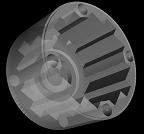
Here is pic of the CF piece i think i'll use for putting pressure down on the Quark to the heatsink surface.
“The modern astrophysical concept that ascribes the sun’s energy to thermonuclear reactions deep in the solar interior is contradicted by nearly every observable aspect of the sun.” —Ralph E. Juergens
|
|
|
|
|
|
|
|
RC-Monster Aluminum
Offline
Posts: 862
Join Date: Dec 2006
Location: Perth, Western Australia
|
04.05.2007, 09:47 PM
The loaded speed for a 7xl is 2145 I think, so 2145 x 16.5 = 35400rpm
The unloaded speed is 2382, so 2382 x 16.5 = 39300rpm
Hope this heatsink turns out well for you though. I've recently damged a second Quark with over heating problems. I use the heatsink from rc-monster, one 40mm fan, one 3'' fan and I don't think I was doing anything other the top with it setup wise, yet it still can't do a 5 minute race on 14 cells.
|
|
|
|
|
|
|
|
RC-Monster Aluminum
Offline
Posts: 748
Join Date: Oct 2005
|
04.08.2007, 01:16 AM
Just to be clear on motor loaded - unloaded business.
If controller can handle it (high RPM) or limit it then there is no harm.
Mechanically Feigao motors rated at 50000 RPM Max (bearing and balancing wise).
Temperature more then 90Deg C is bad because of higher differential temp of magnet (mainly you should worry about magnet) and copper losses. Do not forget about balancing epoxy which can come loose and epoxy holding end-caps.
I am hearing a lot about loaded Kv numbers does anybody knows what the load is? Because there are lots of ways to calculate it and estimate.
With higher RPM current goes up because of inertia of rotor, so their will be RPM when it is less noticeable based on rotor size. And that is where power is dissipated and heat is coming from. And that is another reason not to run BL motors with out load or more correctly without control of RPM.
|
|
|
|
|
|
|
|
Z-Pinch racer
Offline
Posts: 3,141
Join Date: Nov 2006
Location: SK, Canada
|
04.08.2007, 01:23 AM
Well, I did an eagletree test, and what I got was 42,000 rpm max, with a brief full throttle pull.
I can't remember the voltage the eagletree said, but either the volts the eagletree is reporting under load is wrong. OR, the rpm the eagletree is reporting is wrong. I am using the two wire RPM sensor.
Because that would require a voltage of 17.5 volts...... no way! The A123's under a little load will hover around 16 - 16.5 volts.
“The modern astrophysical concept that ascribes the sun’s energy to thermonuclear reactions deep in the solar interior is contradicted by nearly every observable aspect of the sun.” —Ralph E. Juergens
|
|
|
|
|
|
|
|
RC-Monster Aluminum
Offline
Posts: 748
Join Date: Oct 2005
|
04.08.2007, 01:39 AM
Quote:
|
Originally Posted by zeropointbug
Well, I did an eagletree test, and what I got was 42,000 rpm max, with a brief full throttle pull.
I can't remember the voltage the eagletree said, but either the volts the eagletree is reporting under load is wrong. OR, the rpm the eagletree is reporting is wrong. I am using the two wire RPM sensor.
Because that would require a voltage of 17.5 volts...... no way! The A123's under a little load will hover around 16 - 16.5 volts.
|
Well, 2 phases to define RPM is not very accurate, but close enough. If you run this test many times then you can get better averaged value, couple runs is not enough.
5% error will be about 2100 RPM which is good resolution for given sensor pickup.
|
|
|
|
|
|
|
|
Z-Pinch racer
Offline
Posts: 3,141
Join Date: Nov 2006
Location: SK, Canada
|
04.08.2007, 01:48 AM
I have been having voltage reading problems also with my eagletree lately.
It's been approx. 1 volt lower than it should be at max volts. Underload, I couldn't tell you , as there is no way of knowing, right?
“The modern astrophysical concept that ascribes the sun’s energy to thermonuclear reactions deep in the solar interior is contradicted by nearly every observable aspect of the sun.” —Ralph E. Juergens
|
|
|
|
|
|
|
|
Guest
|
Quark problems?? -
04.08.2007, 05:40 PM
Quote:
|
Originally Posted by Patrick
The loaded speed for a 7xl is 2145 I think, so 2145 x 16.5 = 35400rpm
The unloaded speed is 2382, so 2382 x 16.5 = 39300rpm
Hope this heatsink turns out well for you though. I've recently damged a second Quark with over heating problems. I use the heatsink from rc-monster, one 40mm fan, one 3'' fan and I don't think I was doing anything other the top with it setup wise, yet it still can't do a 5 minute race on 14 cells.
|
Does this happen alot?? I was looking at a Quark and NEU motor combo but if it can't do 4S lipo's for more than 5 minutes I don't want to waste my money. will the Quark last the runtime of the batts in an E-maxx?
|
|
|
|
|
|
|
|
Guest
|
04.08.2007, 02:23 AM
I just read through this thread and it just dawned on me that I saw a reference to arctic silver. If you are going to be using that stuff on the inside of the case, I wouldn't. Although it isn't supposed to be electrically conductive, I think that a matter for some debate. In any case arctic silver does exhibit signs of capcitance. Like I said, I'm not real swift on these sorts of things, but to me, capacitance or conductor, I wouldn't go wiping that stuff all over my expensive electrical equipment. I'd use Arctic Alumina.
As for the sink, it looks neat, but where are you going to put it. I have had experience with dealing with heat when messing with LED lighting. LEDs get VERY inefficient when you drive them hard and they produce a lot of heat.
Anyway, I've found that there are two ways to get rid of heat. Or move it to another place. The first is to use a big heat sink. What I mean by big, is mass. Say two to four ounces of aluminum. The other way is to increase surface area to promote convection and we do this through the use of fans. The problem with this is that air is a very poor conductor of heat. You have to move a LOT of air for it to be effective. The way that we are using fans is to make up for the use of small heat sinks.
Not to get off on a tangent or anything, but I'm bored, so here I go. You could do a little experiment. Take a piece of metal, like a 5.5mm connector. Hold it up with something that doesn't conduct heat very well, like a clothes pin and then hold it over a cigarette lighter (lit of course, LOL) for about 30 seconds. Get it good and hot and then blow on it and see how long it takes to cool to a point that you can hold it in your hand. Now, do this again, but instead of using a fan, just set the connector down on it's end to get good contact on a thick piece of aluminum or even steel and then see how long it takes before you can hold it. I'll bet that it will cool faster by just setting it down on the "sink" than it does by blowing on it.
Anyway, I like the heat sink that you are making. It looks cool, but if you want a heat sink that big with a lot of surface area, why don't you just mount it to the chassis?
|
|
|
|
|
|
|
|
RC-Monster Admin
Offline
Posts: 10,480
Join Date: Feb 2005
|
04.08.2007, 02:48 AM
Artur; in some cases the magnets get loose/split on the feigao shafts.
I thought neodymium looses it's power at 110 degree C.
About the load that they put on the motor; they do give the Kv and the current it can 'handle'. i wouldn't be surprised if they used a fixed voltage for some odd reason. or they simple determine the max. load by the resistance/thickness of copper
|
|
|
|
|
|
|
|
RC-Monster Aluminum
Offline
Posts: 748
Join Date: Oct 2005
|
04.08.2007, 10:19 AM
Quote:
|
Originally Posted by Serum
Artur; in some cases the magnets get loose/split on the feigao shafts.
I thought neodymium looses it's power at 110 degree C.
About the load that they put on the motor; they do give the Kv and the current it can 'handle'. i wouldn't be surprised if they used a fixed voltage for some odd reason. or they simple determine the max. load by the resistance/thickness of copper
|
Good point, Rene, centrifugal force can split magnet. And we seen number of motors with broken magnet not only from Feigao...
At 110C lots of things going bad, but at 130+C you will destroy magnet permanently, that what I was referring to. (I've got couple of those from my friends, saying they are weak... guess what they cannot even stick to refrigerator door :) )
About load, it is a dark territory with proprietary sign for RC, I guess.
For voltage measurment, keep in mind the correct is to measure voltage on the motor, not through connectors and FET's. Very difficult, but then do not expect exact matching with datasheets.
|
|
|
|
|
|
|
|
RC-Monster Admin
Offline
Posts: 10,480
Join Date: Feb 2005
|
04.08.2007, 03:03 AM
What voltage meter do you use? i've got a calibrated Fluke, and it's dead accurate according to that. (at least, my eagletree V1 was, i've got a V2 now and will do some measurements on it, i noticed they used slightly different components in it.)
You can calibrate the eagletree software with this voltage difference.
|
|
|
|
|
|
|
|
Z-Pinch racer
Offline
Posts: 3,141
Join Date: Nov 2006
Location: SK, Canada
|
04.08.2007, 03:18 AM
I did calibrate it once, after I did that, the voltage readout was only slightly diff, and it was VERY fuzzy, or NOISY. I'll try it again tomorrow though.
Also, AAngel, teh Arctic Silver thermal adhesive is non-conductive, and SLIGHTLY capacitive. I will take care applying this though, I am going to apply a thin layer onto the heatspreader, and then apply it to the FET's. And then I will do this again to attach it to teh Quark case. Then I will use regular Arctic Silver thermal paste between the case and the big @$$ heatsink.
About the heatsink, it is designed for very low airflow rates, the stock fan that came with it was only 17cfm or something near that. The airflow that it will see in action on a truck will be far greater than this. Not that I would need airflow anyways, it would do a VERY good job without it even.
“The modern astrophysical concept that ascribes the sun’s energy to thermonuclear reactions deep in the solar interior is contradicted by nearly every observable aspect of the sun.” —Ralph E. Juergens
Last edited by Serum; 04.08.2007 at 04:13 AM.
|
|
|
|
|
|
|
|
Guest
|
04.08.2007, 04:18 AM
I still don't get it. The sink obviously doesn't have any mass, so it can't pull much heat away from the esc before it gets to be as hot as the esc is. It has to rely on dissipating the heat into the air around the fins and then getting that hot air out and cool air in to repeat the process. I don't see how you can say that the sink will work without fans. So, this thin aluminum has all of these fins with the purpose of moving the heat from the sink to the air around the fins. So what happens when the air around the fins is the same temp as the sink itself and there's no fan to get the hot air out and cool air in. You have to move the air, because, as I said, air is a horrible heat conductor. The hot air isn't going to pass its heat off to the air around it.
I also don't know how you can say that the sink effectively dissipated that much heat with very little air flow. I'm going to assume that you are talking about the sink being inside of a computer case. If that is true, you can't say that there isn't a lot of air flow. Not only are fans in computer cases designed to move air, but they are placed inside the cases in places where they will be the most effective.
I'm also not getting your mentioning more fins working better with higher airflow and fewer fins working better with lower air flow. I can understand that if you have a given area with say 10 fins, you have to have a higher pressure air flow to cool it than the same area with 5 fins. It's kind of like flowing water through a pipe. With a 1" diameter pipe, you'd have to have a higher pressure/flow to move X amount of water in a given time than you would with a 2" diameter pipe. The larger pipe can flow the same amount of water at less pressure, but it is none the less moving the same amount of water. In this case, since you have lots of fins, the pressure of the air going through the fins is going to be higher than it would be if your sink had fewer fins. Are you saying that your sink is going to work better in this case with little air flow. If so, I'm not following.
I'm not trying to be argumentative. I'm must hoping to learn something.
It still seems to me that attaching the esc to the chassis is the best way to keep it cool. Lots of surface area, inspite of the lack of fins, and lots of mass to store heat until it can be dissipated. I wonder how long it would take an esc to heat a chassis up to 160 degrees F.
|
|
|
|
|
|
|
|
Z-Pinch racer
Offline
Posts: 3,141
Join Date: Nov 2006
Location: SK, Canada
|
04.08.2007, 01:19 PM
Quote:
|
Originally Posted by AAngel
I still don't get it. The sink obviously doesn't have any mass, so it can't pull much heat away from the esc before it gets to be as hot as the esc is. It has to rely on dissipating the heat into the air around the fins and then getting that hot air out and cool air in to repeat the process. I don't see how you can say that the sink will work without fans. So, this thin aluminum has all of these fins with the purpose of moving the heat from the sink to the air around the fins. So what happens when the air around the fins is the same temp as the sink itself and there's no fan to get the hot air out and cool air in. You have to move the air, because, as I said, air is a horrible heat conductor. The hot air isn't going to pass its heat off to the air around it.
I also don't know how you can say that the sink effectively dissipated that much heat with very little air flow. I'm going to assume that you are talking about the sink being inside of a computer case. If that is true, you can't say that there isn't a lot of air flow. Not only are fans in computer cases designed to move air, but they are placed inside the cases in places where they will be the most effective.
I'm also not getting your mentioning more fins working better with higher airflow and fewer fins working better with lower air flow. I can understand that if you have a given area with say 10 fins, you have to have a higher pressure air flow to cool it than the same area with 5 fins. It's kind of like flowing water through a pipe. With a 1" diameter pipe, you'd have to have a higher pressure/flow to move X amount of water in a given time than you would with a 2" diameter pipe. The larger pipe can flow the same amount of water at less pressure, but it is none the less moving the same amount of water. In this case, since you have lots of fins, the pressure of the air going through the fins is going to be higher than it would be if your sink had fewer fins. Are you saying that your sink is going to work better in this case with little air flow. If so, I'm not following.
I'm not trying to be argumentative. I'm must hoping to learn something.
It still seems to me that attaching the esc to the chassis is the best way to keep it cool. Lots of surface area, inspite of the lack of fins, and lots of mass to store heat until it can be dissipated. I wonder how long it would take an esc to heat a chassis up to 160 degrees F.
|
About the fewer fins working better with a lower airflow FAN I meant to say, also, when each individual fin is larger too. For a larger # of fins, they are usually small, and more densely packed, correct? So, for a given fan, it has to overcome alot more back pressure (because of surface area of fins, skin resistance), thereby reducing the overall amount of air actually traveling through the fins.
Another example, the PC i'm on now is highly overclocked, running a core 2 duo 2.4 overclocked to 3.6ghz. This takes upping the core voltage, and frequency, and some other settings.... anyways, the heat dissipation goes from the rated 65watt TDP, up to approx. 110 watts of heat at 100% CPU usage. The heatsink I am using is a large tower heatsink, anyways, it doesn't matter if I turn the heatsink fan ON, or OFF, the CPU temperature increases only up to 2 degrees. So then, the only thing keeping some cooler air inside the fins is the airflow through the case, which isn't a whole heck of alot.
This heatsink does have some mass to it btw, it's approx. 120 grams, or was it 140 grams, can't remember, it's on a previous post.
To get to the point, this heatsink will have more than enough airflow to work wonders if situated in a half decent spot.
Just for reference, I measured each fin, and came up with this surface area. Total surface area is about 1.23 square meters of area. The heatspreader is 2.5mm thick, the fins are .4mm thick, and the fin spacing is about 1.6mm.
The thin fins have something to do with not needing much airflow to stay cool. The amount of heat energy present with a Quark will won't need much like i've said before. It should have plento-airflow however. Also, surface texture has alot to do with surface resistance (obviously), they have a fine gold ball texture to them, with cuts down on resistance.
One last comment, when I was grinding this thing, after I took it off from heavy grinding, a few seconds, and the area I was grinding was only luke warm, before that I could not touch it; that was after moving the heatsink back and forth a few times in the air, not very fast either. It simply doesn't need much to work properly, it's an efficient cooler.
“The modern astrophysical concept that ascribes the sun’s energy to thermonuclear reactions deep in the solar interior is contradicted by nearly every observable aspect of the sun.” —Ralph E. Juergens
|
|
|
|
|
Currently Active Users Viewing This Thread: 1 (0 members and 1 guests)
|
|
|
Posting Rules
|
You may not post new threads
You may not post replies
You may not post attachments
You may not edit your posts
HTML code is On
|
|
|
Powered by vBulletin® Version 3.8.11 Copyright ©2000 - 2025, vBulletin Solutions Inc.
vBulletin Skin developed by: vBStyles.com
|
 |