
 |
|
|
|
|
|
 |


|
|
 |
 |

|
 |

|
(#2)
|
|
Check out my huge box!

Offline
Posts: 11,935
Join Date: Aug 2007
Location: Slidell, LA
|
04.09.2008, 11:10 PM
Got my medusa 36/60/1500 today. Motor looks nicely made, and the windings look good too. Packaging and labels are a bit cheap, but that is the place to save a few bucks IMO! I do not care for the color, but I will try the motor in my hyper8. Performance is what I am looking for!
|
|
|

|
 |
 |
 |
|
|
|
|
|
|
(#3)
|
|
|
RC-Monster Carbon Fiber
Offline
Posts: 87
Join Date: Mar 2008
Location: Rethymno, Greece
|
04.10.2008, 03:35 AM
Quote:
you got the v1 or the v2 version? i think medusas are somewhat 'neu rip-offs'... the rotor is 4pole,segmented, and housed inside a carbon shell [instead of kevlar; i guess that saves some bucks,but it`s a lot better than nothing], and the stator is slotted [don`t recall if it`s 8 or 12 slots though -it`s been almost a month since i teared my 36-50-2200v2 apart to check the insides]. the construction seems solid, even though the motors are designed in usa but made in china i believe [that also helps keeping the costs down]. nonetheless, i think they are a good option for those average bashers out there, who [at most cases] are between a cheap feigao [or ammos and similar -disposable- motors] and an expensive neu [or lehner]. now what we want, is 70-75mm medusas for our heavy trucks 
|
|
 |
|

|
|
|
|
|
|
|
|
|
(#4)
|
|
RC-Monster Carbon Fiber

Offline
Posts: 351
Join Date: Dec 2007
Location: Central PA
|
04.10.2008, 12:35 PM
A longer can usually means more torque right?
|
|
|
|
|
|
|
|
|
|
|
|
|
(#5)
|
|
|
Guest
Posts: n/a
|
04.10.2008, 12:57 PM
Quote:
|
|
|
|
|
|
|
|
|
|
|
|
|
|
(#6)
|
|
|
Check out my huge box!
Offline
Posts: 11,935
Join Date: Aug 2007
Location: Slidell, LA
|
04.20.2008, 11:59 AM
Quote:
How do you get the can apart? I guess that the rear endbell is pressed on? I tried to disassemble an aveox motor that I had bud did not have any success. |
|
|
|
|
|
|
|
|
|
|
|
|
|
(#7)
|
|
|
RC-Monster Dual Brushless

Offline
Posts: 5,139
Join Date: Sep 2006
|
04.20.2008, 03:51 PM
Quote:
|
|
|
|
|
|
|
|
|
|
|
|
|
|
(#8)
|
|
Guest
Posts: n/a
|
04.10.2008, 03:01 PM
kostaktinos_mt, Thanks for the quick education on the in's and out's of surface brushless systems. You gave me some good info to consider. It certainly makes sence that the bearings will have much more dirt and crud to deal with in a truck than in my helis, and planes. Unfortunatly I'm having a hard time accepting this. I basicly need to throw all my ingrained experiance from aircraft out the door and accept what you guys have learned through trial and error.
But as an experiment I think this was worth the time, just from the respect that I now know I dont need 2000+watts to match the performance of my FLM EXT Big block T. Since nothing has been purchased specificly for the E-maxx yet I learned a cheap lesson with the Ammo!! Weather has been cold and wet all week so I haven't had a chance to drive since Sunday night. But I have been thinking hard. With trying to keep the motor RPM's down around 30k, how do outrunner motors do in surface vehicles?? I know most larger helis(See I cant let it go) use outrunners because they tend to produce the best power at around 30k which lets the heli guys run a larger pinion with more teeth contacting the main gear, it's very rare in helis to see inrunners geared for less than high 30k rpm's. http://www.innov8tivedesigns.com/ind...cPath=21_25_65 I'm thinking the 1400kv on 8s A123 or the 1900kv on 6s A123. I could also drop to a 4s A123 pack with the Medusa to get the RPM below 40k, I think the drop in available watts would be too much though, unless the medusa can stand 110+a bursts. I did plan to try it on 4s and still will, 19t/65t combo looks decent for top speeds I believe Medusa was up and running before Neu, so the V1's were probably more Aveox copies, the V2's could be influanced by the Neu design. Since Neu took over the Aveox model motors it makes sence that all these motors would resemble each other. I agree with the 70-75mm Medusa, I had almost discounted them because of their lack of size. When I siezed the bearing in the Ammo I ordered the Medusa as a replacement before I even checked the Ammo out to see what happened, figured the rotor let loose. |
|
|
|
|
|
|
|
|
|
|
|
|
(#9)
|
|
RC-Monster Carbon Fiber
Offline
Posts: 351
Join Date: Dec 2007
Location: Central PA
|
04.12.2008, 12:41 PM
Would the 35-60-2000V2-5 be a good replacement for a Feigao 8XL? Running 5S in a LST2 with Hydra 120.
This motor is similiar in size and KV to the Feigao 12L but it is double the max amps. |
|
|
|
|
|
|
|
|
|
|
|
|
(#10)
|
|
RC-Monster Carbon Fiber
Offline
Posts: 87
Join Date: Mar 2008
Location: Rethymno, Greece
|
04.13.2008, 11:34 AM
buzzsaw,
sorry for the delayed response, i was kinda busy the past two days. i agree, cars and aircraft have quite some differences in both theory and real-world. besides dirt, bearings in cars [not just motor bearings; all bearings] suffer severe mechanical shocks. for example when landing after a jump, hub bearings [those that support the wheels] take a serious hit; and if the quality and size aren`t up to par [weight of the vehicle], they fail. for example, if you do a quick search on the old traxxas stampede you will find that people were killing 5x8 bearings in no time, and then replaced the stock carriers in favor of aftermarket ones that could hold larger bearings. same applies [in a lesser extend] to all car bearings, even motor ones and transmission bearings too. when a truck lands after a jump, the wheels stall momentarily, thus causing a massive mechanical shock/wave beating from the wheels to the motor. if this shock isn`t absorbed [slipper clutch], something will break throughout the chain. if there is nothing to bend [tranny or diff case] or break [axles,cvds,shafts,diffs,gears], then the bearings take the impact; usually leading to grindy bearings that spit a tone of heat once they see high rpm again. some years ago, we were beefing up our emaxxes to handle bl power, and i remember that everytime something was 'steel-ed',something else failed. first it was universals, so we used steel cvds, then it was the stock diffs so we used RR ones, then it was tranny gears, so we used steel gears, then it was the tranny case, so we came up with alloy ones, and then the motor shafts started breaking [feigao 's' and aveox was popular back then], so we used 5mm shafts, and then finally, rims were getting cracked. all these problems went away when the slipper clutch was upgraded and carefully tuned. so i have come to believe that there isn`t a thing such as 'bulletproof drivetrain'. ultimately, the heavier a vehicle is and the higher the power that 'feeds' it, the higher the necessity of a slipper clutch is. finishing my thoughts about this matter, i recall some hardcore rock-crawling guys running their trucks with bushings instead of bearings. reason is, that bearings break under the massive torque being produced between counter shafts and counter gears in the transmission, whereas bushings survive this effect without serious efficiency losses [since it`s low rpm, bushings vs bearings doesn`t make any considerable difference,nor efficiency is a primary goal of rock-crawling]. outrunners do well in cars and trucks, and some people are running their vehicles with the 'no center tranny, but an outrunner' concept. it works well, but removes the slipper clutch [which is bad imo]. outrunner + tranny also works well, but mostly for rock-crawling it is being used [where torque is half the world]. another aspect that i am sure many will debate and argue, is that most [not all] outrunners don`t easily put their efficiency above the 90% mark... which is already a reality for good inrunners [eg: plettenberg,neu]. that said, i personally still like outrunners at some applications, but i won`t agree in blind with the 'outrunner is always better than inrunner' idea. i think your current medusa on 4s [lipo] should do fine [with proper gearing; i would personally start with a 16t and stock spur], although a 36-60-2000v2 on 5s would be perfect in terms of efficiency,reliability, and performance potential. 6s and 36-60-1500v2 would be close to 'as good as it can be'. as for the feigao 8xl vs 36-60-2000v2: i had a kb45 8xl [1700kv] in my lgt, and i am seeing similar performance [and temps] between the kb45/14cells nimh and the 36-60-2000v2 on 5s lipo. so i think the feigao 8xl is close to the 36-60-2000v2 [performance wise], but still not as efficient. in a heavy lst2 conversion, i think the medusa still has the upper hand when compared with the feigao, but still it`s quite small to run ideally; and thus a kb45 would be a better fit in that application. hence my comment about a 75mm long medusa...
|
|
|
|
|
|
|
|
|
|
|
|
|
(#11)
|
|
Guest
Posts: n/a
|
04.12.2008, 06:00 PM
Looking at nothing but the specs I would suspect the Medusa to be better than either of the Feigaos, lower resistance and no load draw. Weather it can comfortably replace an XL motor is not known for sure. It's a bit smaller than a Neu 1512 but longer than a 1509, from what I've seen the 1515 and 1521 seem to be the Neu's to have in big heavy trucks.
The 36-50-3300 is doing well in my light(stock) Emaxx, not crazy powerful but enough to make it more fun than the titans. The weather here this week was a washout so I haven't been able to get any more run time all week, tomarrow looks nice, finally, haven't seen the sun in a week! |
|
|
|
|
|
|
|
|
|
|
|
|
(#12)
|
|
Guest
Posts: n/a
|
04.13.2008, 01:31 PM
I agree on the outrunner issue they have there place but not ideal in all situations.
I'm running a 5s A123, very close to 4s Lipo voltage. So the 15t/68t combo I have on it now should be in the good range  I was thinking ~2000kv for 6s2p A123 would be good, not sure if I can get away with 8s1p, 8s2p is way too heavy, Need an HV MM ESC to go 10-12s A123. The more I think about it the more I think 8s1p should be ok, I could get away with 5s1p but I'm not sure 7-8min run times would be enough, 8s with the same power output would give 10-11min runs I was thinking ~2000kv for 6s2p A123 would be good, not sure if I can get away with 8s1p, 8s2p is way too heavy, Need an HV MM ESC to go 10-12s A123. The more I think about it the more I think 8s1p should be ok, I could get away with 5s1p but I'm not sure 7-8min run times would be enough, 8s with the same power output would give 10-11min runsWe were also given a glimpse(verble) of the new Castle/Neu motor by Patrick so I might just wait for the MMM combos, Heavier, stiffer case, larger bearings, and more surface area then the true Neu 1515/1D motors. The only thing I dont care for is they are not going to wrap the rotor  I threw a magnet in my Aveox 1010/2y(unwrapped rotor) at under 30k. The wrapped 2726 rotor I installed has been fine running 40+k. Maybe adhesive tech. has improved enough in the last 10yrs. I threw a magnet in my Aveox 1010/2y(unwrapped rotor) at under 30k. The wrapped 2726 rotor I installed has been fine running 40+k. Maybe adhesive tech. has improved enough in the last 10yrs. Since we all like pics, here is the truck this setup is really for. 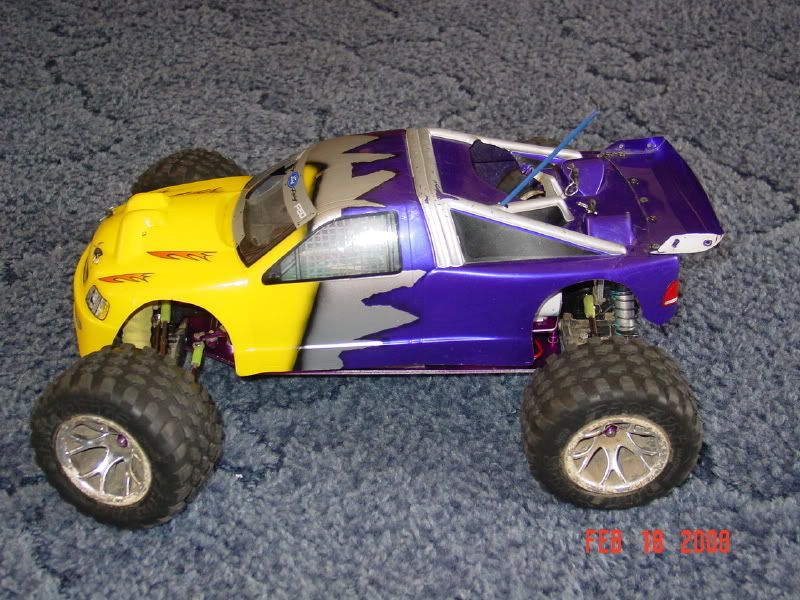 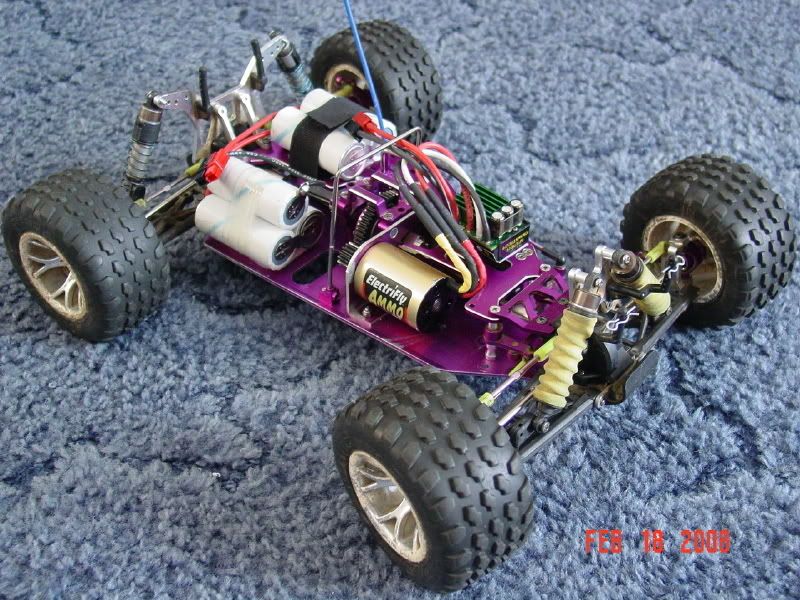 Spur is a 49t, largest pinion I have so far is 14t. Diffs are 13/38(2.923:1). Once I decide on a dedicated ESC/motor for the E-maxx I'll give the EMT it's MM back and try the Medusa and a Hacker C40-8L. Here are some Pics of My sons EMT, it was built by Santa and the Elves  (me and the credit card) For X-mas this year. Hacker C50-13L/MM, 2s A123, 9t/52t gears to keep the speed down. He got a JR R-1 TX for his B'day so it's on a PCM RX now and no glitching like the RTR TX/RX had. (me and the credit card) For X-mas this year. Hacker C50-13L/MM, 2s A123, 9t/52t gears to keep the speed down. He got a JR R-1 TX for his B'day so it's on a PCM RX now and no glitching like the RTR TX/RX had.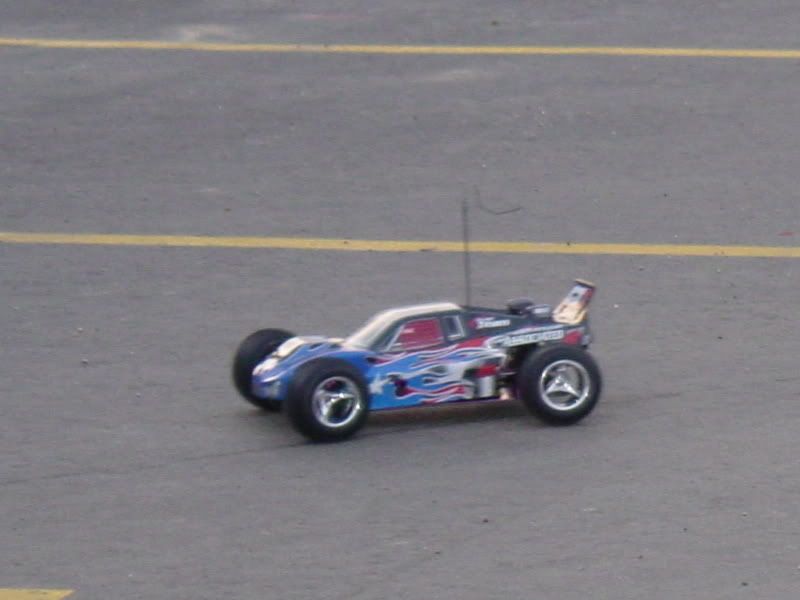 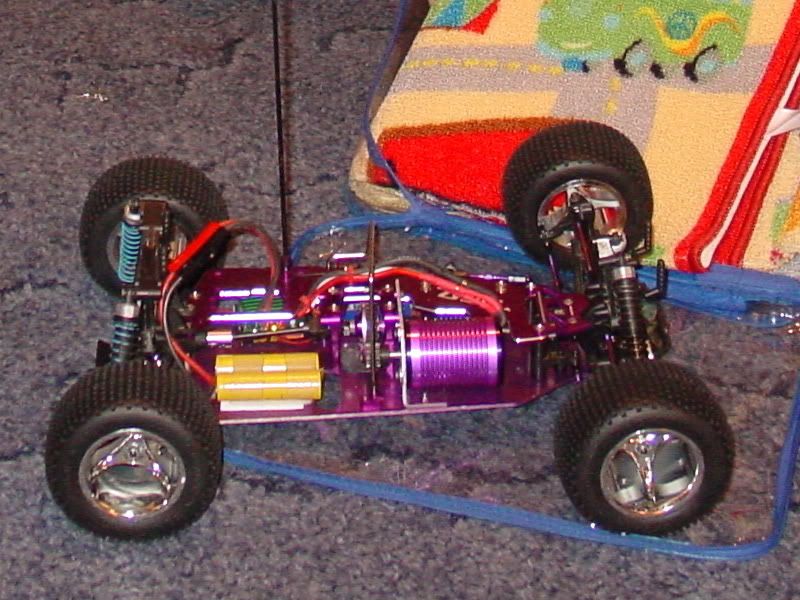 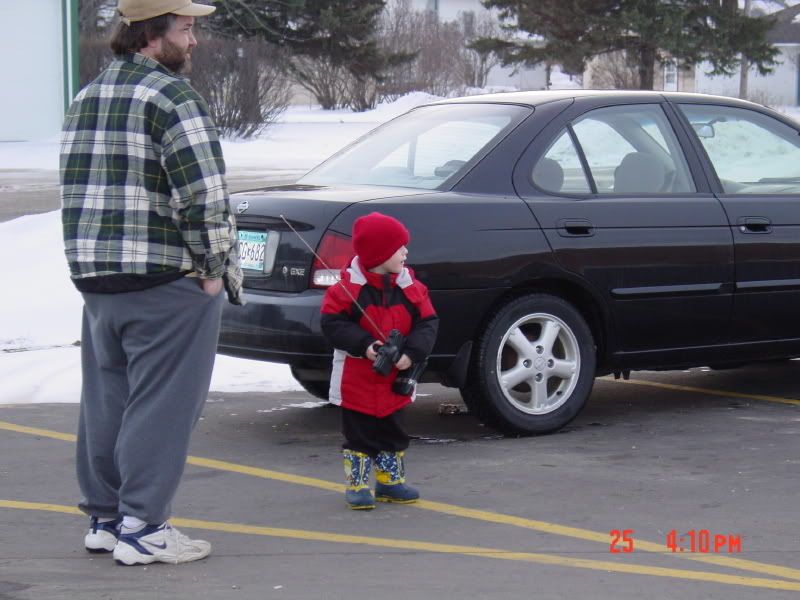
|
|
|
|
|
|
|
|
|
|
|
|
|
(#13)
|
|
working on a brushless for my wheelchair.....

Offline
Posts: 4,890
Join Date: Mar 2007
Location: minnesnowta
|
04.13.2008, 02:32 PM
that's cute. I have more fun watching my son drive my r/c's than I do driving them myself.
It's "Dr. _paralyzed_" actually. Not like with a PhD, but Doctor like in Dr. Pepper. |
|
|
|
|
|
|
|
|
|
|
|
|
(#14)
|
|
Guest
Posts: n/a
|
04.14.2008, 12:16 AM
I thought I had turned the startup power up but I guess not, I did try increasing the timing to 15deg. No motor temp issues(105f after sitting a few minutes), but the ESC was peaking at 150f several minutes after a 10 min average bash session.
I just installed a small fan I harvested from an old laptop. Might need a larger fan though this one really doesn't seem to move much air. I hope just having constant air flow for the ESC will be enough. I was running the 15/68t combo, I dont have a 16t pinion but I do have 65 and 62t spurs so I can hit a ratio either side of 16/68. If I can get the ESC temps down under 140f I will try some taller ratios, I'd like some more top end. Is that MMM shipping yet 
|
|
|
|
|
|
|
|
|
|
|
|
|
(#15)
|
|
Guest
Posts: n/a
|
04.20.2008, 06:08 AM
I sure wish it would stop raining!
Not much going on for bashing around here but I did get it clocked by a radar gun yesterday. I was cought doing 42mph through a rough yard. Still running the 15/68t gears, motor temps are still around 100f, but the fan on the ESC does seem to have helped, I didn't drive long, probably <6min but the ESC never got above 90f. 6 min without a fan had the ESC up to 135f. |
|
|
|
|
|
|
 |
«
Previous Thread
|
Next Thread
»
| Currently Active Users Viewing This Thread: 1 (0 members and 1 guests) | |

 Hybrid Mode
|
|

Powered by vBulletin® Version 3.8.11
Copyright ©2000 - 2026, vBulletin Solutions Inc.
vBulletin Skin developed by: vBStyles.com
Copyright ©2000 - 2026, vBulletin Solutions Inc.
vBulletin Skin developed by: vBStyles.com
