
 |
|
|
|
|
|
 |


|
|
 |
 |

|
 |

|
(#1)
|
|
RC-Monster Admin
Offline
Posts: 10,480
Join Date: Feb 2005
|
04.08.2007, 04:28 AM
he meant there is always an airflow in a vehicle once it's driving.. I thought I was the only one who misinterpreted his words.
|
|
|

|
 |
 |
 |
|
|
|
|
|
|
(#2)
|
|
Guest
Posts: n/a
|
04.08.2007, 04:45 AM
Ok, there is some sort of air flow while driving, but it isn't constant and it isn't always coming from the same direction.
Hey, lets just wait until he installs it and see what happens. Who knows, I might be making one of these next week. |
|
|
|
|
|
|
|
|
|
|
|
|
(#3)
|
|
RC-Monster Admin

Offline
Posts: 14,609
Join Date: Nov 2005
Location: Des Moines, IA
|
04.08.2007, 01:26 PM
Any heatsink really has two parts; mass to pull heat away from whatever it is cooling; and surface area to dissipate that to the air. In my experience, tall fins don't work as well as shorter fins because the heat has to travel all the way up each fin. The only advantage to having tall fins is that more air goes through it.
|
  |
|
|
|
|
|
|
|
|
|
|
(#4)
|
|
|
RC-Monster Aluminum
Offline
Posts: 748
Join Date: Oct 2005
|
04.08.2007, 01:39 PM
Quote:
Depends on material of heatsink (heat transfer properties...) so longer fins (higher differential temp) will do better jobs on materials with higher heat transfer rates. As example copper will work better with long fins while aluminum not. But fins configuration and flow design can improve that process. And you can make thinner copper heatsink with longer fins, but complexity and mechanical softness will be a major problem. |
|
|
|
|
|
|
|
|
|
|
|
|
|
(#5)
|
|
Z-Pinch racer

Offline
Posts: 3,141
Join Date: Nov 2006
Location: SK, Canada
|
04.08.2007, 01:59 PM
It's not that longer fins don't work as 'well' as shorter fins. If you want to look at it another way, from heat source, one side of fin, and temp measurement other side, it will lower the longer the fin. Longer fins will work better, only marginally better though. Heatsink design really is tricky, now there are fancy heatsinks (for CPU's) with a bunch of heatpipes and large amounts of fins. Heatpipes, if you don't know what they are, have distilled water, or alcohol under very low pressure, which vaporizes at a very low temp, which you know phase change takes alot of energy. Also, unlike a solid piece of metal (such as copper), heatpipes thermal resistance decreases as length is increased.
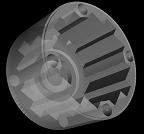
For this heatsink, it's good that the fins are of decent length, for one: to catch air, and two: inside the fins, there is a certain amount turbulence which spreads around the heat energy down the length of the fins. I am thinking of mounting it in front of the transmission right behind the front shock tower. If not enough room, other side of chassis, where it will still get enough airflow. I just did a little experiment with a 600 watt heatgun, with a low speed fan. With the heatgun of the heat spreader for almost 1 minute, with the fan running (rated 19cfm), after this period, the heatspreader was quite warm, I would guesstimate it was 45C (113F), and VERY quickly cooled down to room temp within 15 seconds. Not convinced yet? :032: :005: |
|
|
|
|
|
|
|
|
|
|
|
|
(#6)
|
|
|
RC-Monster Aluminum
Offline
Posts: 748
Join Date: Oct 2005
|
04.08.2007, 02:30 PM
Quote:
|
|
|
|
|
|
|
|
|
|
|
|
|
|
(#7)
|
|
|
Z-Pinch racer
Offline
Posts: 3,141
Join Date: Nov 2006
Location: SK, Canada
|
04.08.2007, 02:32 PM
Quote:
They use wicking in heatpipes now, the texture inside the pipe. Also, these things are very efficient in transferring heat to some other place (fins). gravity has little to no affect on heatpipes now. Why do you think this is SO complicated? Heatsink design is trucky yes, but the basic understanding of heat transfer is simple. |
|
|
|
|
|
|
|
|
|
|
|
|
|
(#8)
|
|
RC-Monster Admin
Offline
Posts: 14,609
Join Date: Nov 2005
Location: Des Moines, IA
|
04.08.2007, 01:56 PM
Yeah, material does matter. I can see copper having better results with longer fins while aluminum having better results with shorter but more numerous fins...
|
|
|
|
|
|
|
|
|
|
|
|
|
(#9)
|
|
|
Z-Pinch racer
Offline
Posts: 3,141
Join Date: Nov 2006
Location: SK, Canada
|
04.08.2007, 02:03 PM
Quote:
It wouldn't make much of any difference using copper fins rather than aluminum fins. I've seen this lot's with CPU heatsinks, copper version of the very same one, was only 2-3 C lower temps than aluminum one. The most important part is the heatspreader, which SHOULD be copper, as that is where the highest heat density is, right? |
|
|
|
|
|
|
|
|
|
|
|
|
|
(#10)
|
|
RC-Monster Admin
Offline
Posts: 14,609
Join Date: Nov 2005
Location: Des Moines, IA
|
04.08.2007, 02:05 PM
Nope, not convinced! ;) You forget that I abhor the use of fans for R/C applications, so the majority of the tall-fin benefits are lost. Agreed, CPU applications are much different...
|
|
|
|
|
|
|
|
|
|
|
|
|
(#11)
|
|
Z-Pinch racer
Offline
Posts: 3,141
Join Date: Nov 2006
Location: SK, Canada
|
04.08.2007, 02:16 PM
Which part are you not convinced about?
How about this, once I get my thermal adhesive, my thermal probe (infrared), and my truck up and running, we will see how well it works. I know with absolute certainty that this will work super fan-taz-magorical. Don't forget about air convection through the fins too (without fan, or direct airflow), as I also tried using no fan with the heatgun. I couldn't get it over a temp that I couldn't put right to my cheek right after, from about 1 minute of blowing the heatgun directly on the heatspreader, about 2cm away. |
|
|
|
|
|
|
|
|
|
|
|
|
(#12)
|
|
Guest
Posts: n/a
|
04.08.2007, 03:03 PM
I figured I'll post here, instead of making a new thread, not to take away from zero's posts, but it's very similar..
ok, so i'm hoping my motor mount will be in tommorow, and i'll be ready to go, so i decided to do some last minute mods, to make sure my lsp's off on the right foot.. started to take the quark apart, and i'm stuck..      I know there's another set of pins/jumpers tward the end with the motor plugs, but i can't seem to un-plug them, so not sure if there's something else in the way or not.. and the controller seems to be VERY secure to the bottom of the case.. so what do you guys think? my controller's a few months old now, so i'm guessing it's the same as all the others with heat problems, but i've yet to get it hot, because it's been in my onroad car.. I've got a big selection of computer heatsinks to choose from, and am thinking about ditching the quark's case all together.. but someone want to re-describe how to dissasemble this? sorry for being thick, but it just doesn't seem to want out of it's case :002: |
|
|
|
|
|
|
|
|
|
|
|
|
(#13)
|
|
Z-Pinch racer
Offline
Posts: 3,141
Join Date: Nov 2006
Location: SK, Canada
|
04.08.2007, 03:21 PM
Hey, yes, like Brian said. You just have to get a small screw driver where the battery power in wires come in, and put moderate pressure up, it should start crackling and start to come off.
THen what I did to take the heatspreader off the FET's, was use the plastic end piece as a leverage spot, and put the screw driver tip just under the pad (where there are no FET's) and do the same thing. However, it's stuck on the FET's better than it is to the case, so just constant pressure up with leverage on the screw driver, and it should slowly start crackling and lift off. Would you mind posting pics of the heatsinks you have? I'm curious what you have. |
|
|
|
|
|
|
|
|
|
|
|
|
(#14)
|
|
RC-Monster Admin
Offline
Posts: 14,609
Join Date: Nov 2005
Location: Des Moines, IA
|
04.08.2007, 03:13 PM
The whole thing is held by the sticky thermal pad at the bottom. When I removed mine, I took a small flat-bladed screwdriver and gently pried the heatspreader off the case. Then, even more carefully, pried the heatspreader off the FETs. Gotta be careful here as the casing on the FETs can break.
You could take it completely out of the case, attach a larger heatsink, wrap the rest of it in heatshink, and then cut a hole for the heatsink like how the BK Warriors are built. But, having a nice metal enclosure is one of the nice things about the quark as it helps to protect everything else. Oh, and those pins connecting the two boards are soldered in. They are very close to some other surface mount devices so be careful if you decide to desolder the pins! Those nearby surface mount parts can easily be damaged by heat and there goes your $280 controller! |
|
|
|
|
|
|
|
|
|
|
|
|
(#15)
|
|
Guest
Posts: n/a
|
04.08.2007, 04:33 PM
hmm and where's the part that's not getting a good thermal contact? I just kinda felt like jumping into this when I woke up.. 3mm shim's needed where? because it all seems like it's got good contacts between the fets and the bottom of the case.. i don't see it moving anywhere.. debating if I should just throw a heatsink on it, and see if it thermals, and worry about dissecting it later, if problems arise? I tried w/ a small flathead, but the dozen or so flatheads that are small enough, aren't long enough to reach the metal shim.. about 1mm too short =\
here's the heatsinks I've got at home.. there's an AMD Athlon stock HS on the left, and the rest are either older CPU heatsinks, or northbridge heatsinks.  and here's an old hard drive with some heatsinks.. I just think it's funny to have heatsinks on a 5400rpm hard drive lol  then i've got some old motherboards and videocards (tnt2's and voodoo3's) out in the garage, with a wide array of heatsinks.. if I need.. at my work, we've got alot of old computers, w/ a very diverse selection of heatsinks.. you should see how big the heatsinks are on some of the older servers.. oct-cpu servers and such have 6"x6"x4" or so heatsinks :) |
|
|
|
|
|
|
 |
«
Previous Thread
|
Next Thread
»
| Currently Active Users Viewing This Thread: 1 (0 members and 1 guests) | |

 Hybrid Mode
|
|

Powered by vBulletin® Version 3.8.11
Copyright ©2000 - 2026, vBulletin Solutions Inc.
vBulletin Skin developed by: vBStyles.com
Copyright ©2000 - 2026, vBulletin Solutions Inc.
vBulletin Skin developed by: vBStyles.com
