
 |
|
|
|
|
|
 |


 |
Eagle Tree of MMMv2 death |
 |

|
 |

|
(#1)
|
|
Never Fast Enough
Offline
Posts: 914
Join Date: Jul 2005
Location: UT
|
Eagle Tree of MMMv2 death -
08.30.2008, 04:15 AM
I happened to be recording an Eagle Tree log when my MMMv2 gave up the ghost on its second day of bashing. I don't know if it will help anybody, but here it is just in case it could be of some use to someone.
E-Revo - MMMv2 - 9XL - 24/65 - 4s 8k lipo. I know my set-up is mild enough because my stock MM/CCBEC works like a champ in there, as did my MMMv1 before I sold it to a friend. The v1 is still running strong. 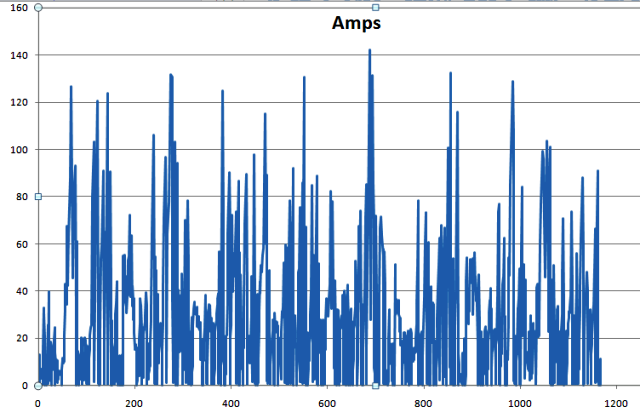
|
|
|

|
 |
 |
 |
|
|
|
|
|
|
(#2)
|
|
Something, anything, nothing

Offline
Posts: 2,747
Join Date: Mar 2006
Location: Houston, TX
|
08.30.2008, 10:11 AM
Nothing looks odd. Seems to average 40-50 amps. Nice to see a real record, good job on that part, but sorry for the loss.
|
|
|
|
|
|
|
|
|
|
|
|
|
(#3)
|
|
I don't understand, but I don't think I like it.

Offline
Posts: 215
Join Date: Dec 2007
Location: Metairie, La.
|
08.30.2008, 10:20 AM
I had an Eagle Tree on mine when it died as well but everything looked good so I never posted it.
|
|
|
|
|
|
|
|
|
|
|
|
|
(#4)
|
|
Never Fast Enough
Offline
Posts: 914
Join Date: Jul 2005
Location: UT
|
08.30.2008, 11:40 AM
The actual average was 5.89A. If you take out the amp values less than 5A, then the average is 22.21A. If you're really bored and do that in increments of 10, then you get this (although you're not sure if it is of any value or has any meaning):
 The samples were taken 10x per second, so count indicates how many samples were in that range from which the average was taken. This shows how rare it is that the higher current was pulled. Of course, the real average shows that too, but I'm very bored. 0A+ avg = 5.89A; count = 7244 5A+ avg = 22.21A; count = 1749 10A+ avg = 28.13A; count = 1257 20A+ avg = 40.52A; count = 662 30A+ avg = 51.96A; count = 388 40A+ avg = 64.81A; count = 225 50A+ avg = 73.91A; count = 156 60A+ avg = 84.99A; count = 99 70A+ avg = 92.28A; count = 73 80A+ avg = 101.87A; count = 48 90A+ avg = 110.15A; count = 32 100A+ avg = 119.10A; count = 21 110A+ avg = 127.41A; count = 14 120A+ avg = 129.58A; count = 12 130A+ avg = 133.33A; count = 7 140A+ avg = 142.34A; count = 1 |
|
|
|
|
|
|
|
|
|
|
|
|
(#5)
|
|
That's All Folks!

Offline
Posts: 2,359
Join Date: Dec 2006
Location: in a VAN down by the RIVER
|
08.30.2008, 06:06 PM
Seems most are still dieing a bec death, need the eagletree servo logging to see what is going on there. Maybe the big digital servos getting in a bind is killing the bec?
|
|
|
|
|
|
|
|
|
|
|
|
|
(#6)
|
|
Never Fast Enough
Offline
Posts: 914
Join Date: Jul 2005
Location: UT
|
08.30.2008, 06:37 PM
It could be the twin servos in the E-Revos that are doing the damage also. The MMMv1 I had that is still running strong was always used with one "weakish" servo. The MMMv2 died with the twin E-Revo servos. Just a thought anyway.
When I get my replacement, I'm only going to use one of the servos and see how long the MMM lasts. |
|
|
|
|
|
|
|
|
|
|
|
|
(#7)
|
|
I don't understand, but I don't think I like it.
Offline
Posts: 215
Join Date: Dec 2007
Location: Metairie, La.
|
08.30.2008, 07:54 PM
My 1st v2 is still running strong on an E-Maxx with 2 200oz digital servos and my 2nd v2 was running 1 very weak analog servo when it died so I doubt it's related to the load.
|
|
|
|
|
|
|
|
|
|
|
|
|
(#8)
|
|
|
RC-Monster Carbon Fiber
Offline
Posts: 109
Join Date: Oct 2007
Location: perth australia
|
08.30.2008, 10:34 PM
the weak servo was probably being overloaded and pulling big current , the strong servos especially 2 of them are probably idling away nicely and not pulling too many amps
Quote:
losi 8ight-t 1515 tekno 1y/MM 4s/5S flight power RIP 4x MMM . MM still lives on ! |
|
|
|
|

|
|
|
|
|
|
|
|
|
(#9)
|
|
RC-Monster Carbon FIBRE NOT FIBER!
Offline
Posts: 701
Join Date: Apr 2008
Location: Brisbane, Australia
|
08.31.2008, 12:57 AM
hmm, but wouldnt it have been utterly stupid of castle to to test this out? like seriously, they deal with huge planes and such, and surely they could do tests to see if the bec would fail with 2 5955tg servos at lock for 10 or so minutes and see if the BECS fail? its starting to look like v1 all over again. poor castle. and poor me whos going to have to pay like $50 just get a working one (STUPID INTERNATIONAL SHIPPING> GRR :)
Monster Max Still Working... JR SX3 Neu 1512 2D/S 12t pinion 4800 zippy-r XRAY xt8 MMM Neu 1512 3D/F 11t pinion 6s 5000 Flightmax/ 4s 4000 Turningy |
 |
|
|
|
|
|
|
|
|
|
|
(#10)
|
|
|
Something, anything, nothing
Offline
Posts: 2,747
Join Date: Mar 2006
Location: Houston, TX
|
08.31.2008, 10:20 AM
Quote:
|
|
|
|
|
|
|
|
|
|
|
|
|
|
(#11)
|
|
Old Skool

Offline
Posts: 7,494
Join Date: Feb 2007
Location: Devon, England
|
08.31.2008, 01:31 PM
My v1 is still working fine, and I use a pair of HS645Mgs- not the strongest setup in the world, but it does for me, and the esc just ticks along merrily.
|
|
|
|
|
|
|
|
|
|
|
|
|
(#12)
|
|
|
Never Fast Enough
Offline
Posts: 914
Join Date: Jul 2005
Location: UT
|
08.31.2008, 04:31 PM
Quote:
Both of the v1s I sold are working perfectly and the v2 I kept died. That's just not right! 
|
|
|
|
|
|
|
|
|
|
|
|
|
|
(#13)
|
|
|
Yip Yip Yip...

Offline
Posts: 1,489
Join Date: Aug 2007
Location: Australia
|
08.31.2008, 08:29 PM
Quote:
Mini-T Pro: Micro Pro 6800kv, Lipo, HS-81mg, Dirt Hawgs M18MT: Quark 33A, Y22S 6000kv, FP 2s Lipo LRP S8-BX: RC-M Conversion, Tekin RX8 B1600KV, 6S. |
|
|
|
|
|
|
|
|
|
|
|
|
|
(#14)
|
|
RC-Monster Titanium

Offline
Posts: 1,161
Join Date: Jan 2008
Location: All over Australia.
|
08.31.2008, 08:39 PM
If you want to sent it registered/insured it cost a bit more. A few months ago I returned my mamba max registered, including a $50 money order, and the cost for the currency conversion, the stupid fee for the international money order, and the registration, came to near $100. Then I went on b-p-p and bought a brand new one for a hair over $100 delivered... but still, shipping wasnt that much ($26? insured to the full au value). The international money order was annoying though, bad time for conversion, plus they charged like an 8% or 10% commision or something. iirc it was like $68 for a $50USD money order.
|
|
|
|
|
|
|
|
|
|
|
|
|
(#15)
|
|
|
Old Skool
Offline
Posts: 7,494
Join Date: Feb 2007
Location: Devon, England
|
09.01.2008, 12:14 PM
Quote:
 Wanna buy a functioning MMM? Only $500.... 
|
|
|
|
|
|
|
|
 |
«
Previous Thread
|
Next Thread
»
| Currently Active Users Viewing This Thread: 1 (0 members and 1 guests) | |
 Linear Mode

|
|

Powered by vBulletin® Version 3.8.11
Copyright ©2000 - 2026, vBulletin Solutions Inc.
vBulletin Skin developed by: vBStyles.com
Copyright ©2000 - 2026, vBulletin Solutions Inc.
vBulletin Skin developed by: vBStyles.com
