
 |
|
|
|
|
|
 |


 |
 |

|
 |

|
(#241)
|
|
RC-Monster Aluminum

Offline
Posts: 905
Join Date: Aug 2007
|
12.07.2007, 04:01 PM
Im ok, I was trying to do windmills on top of an ab ball, fell off backwards and yanked my neck and back. Wish I was still 16 and made of rubber.
On your startup with the DD, when do you call it a good startup? When you can punch it and get instant acceleration every time? I will post pics this evening of my build, seems that it will always start up but the tire size has a lot to do with how fast I can roll into the throttle. |
|
|

|
 |
 |
 |
|
|
|
|
|
|
(#242)
|
|
|
RC-Monster Brushless
Offline
Posts: 2,085
Join Date: Sep 2007
|
12.07.2007, 06:51 PM
Quote:
Instant Acceleration from WOT at any speed is the goal. With the 80amp ESC, I feel like the surge might have been overtaxing. WOT would squeel at anything less than about 5 to 10mph. I know the 80amp ESC was being pushed to it's limits, since If I ran HARD, it would thermal. Tonight I'm going to install the Monster Pro 125 amp ESC with a 2700uf Cap rated at 25 volts. This is Novak's pick of Caps, so I'm thinking it will be enough. I got some thermal compound for the base of the ESC. This will insure a really good thermal exchange with the Aluminum Mount. One thing I noticed with the 80amp ESC, if I had the wheel turned and tried to start from a dead stop, it didn't like that for some reason. Voltage drop from the internal BEC being loaded? Well that's gonna be a thing of the past too. I will install the 10 amp CC BEC as well. This will also remove ESC heat added by the internal BEC. I also found a neat little micro toggle switch at Radio Shack that I think I will put on the ESC for on/off. I plan to shorten the motor/esc wires and use the connectors that came with the Monster Pro. They are alot bigger. 5mm I believe and have a higher amp rating. In light of the problems that plaque the Mamba Max setup, I'm sure the 4mm connectors are barely holding their own in this setup. In fact, if there is any internal arcing going on inside motor connectors, this will make it cog as well. 
|
|
|
|
|

|
|
|
|
|
|
|
|
|
(#243)
|
|
Check out my huge box!

Offline
Posts: 11,935
Join Date: Aug 2007
Location: Slidell, LA
|
12.07.2007, 09:13 PM
Do you have a castle link to program the ccbec?
I set mine to 6.5 volts in my revo and am running a 9001 airtronics and a futaba 3050 and neither even get warm with that voltage. Plus the airtronics servo will almost turn the truck if you hold the front wheels still! You will notoce a big difference eliminating the internal bec on the quark. I have even done it on my 65 roadster and it works well. I have a few $7 CCB (chinese crap becs) and when wired and placed correctly they will work without interference. The ccbec is far superior and only about 3 times the price, a killer deal for a necessary component! The internal bec just can't keep up with the demands a high torque servo(s) can place on it. They work ok in 10th scale vehicles on 2-3s with medium duty servos, that is about the best you can hope for. |
|
|
|
|
|
|
|
|
|
|
|
|
(#244)
|
|
Z-Pinch racer

Offline
Posts: 3,141
Join Date: Nov 2006
Location: SK, Canada
|
12.07.2007, 09:24 PM
Hey Sike, I have been away on a small getaway for the past week.... anyways, I was wondering how the direct-drive truck is coming along? Anything new? (being lazy, haven't read the posts)
|
|
|
|
|
|
|
|
|
|
|
|
|
(#245)
|
|
|
RC-Monster Brushless
Offline
Posts: 2,085
Join Date: Sep 2007
|
12.07.2007, 09:38 PM
Quote:
Welcome back ZPB! I've missed you man. Hope you had fun on your get away. Things are going GREAT! I'm at the kitchen table tonight installing some new upgrades. You need to catch up here. There are some Video's back a page or two. I'll be shooting some more as soon as things dry up some around here.
|
|
|
|
|
|
|
|
|
|
|
|
|
|
(#246)
|
|
|
RC-Monster Brushless
Offline
Posts: 2,085
Join Date: Sep 2007
|
12.07.2007, 09:40 PM
Quote:
I don't have the Castle Link yet, but I'm happy with the 5.0 volt output. Just as long as I get that extra heat/amp load off the ESC. The good thing about this is, if I do decide to go with a HV setup, I have the BEC at least.
|
|
|
|
|
|
|
|
|
|
|
|
|
|
(#247)
|
|
RC-Monster Brushless
Offline
Posts: 2,085
Join Date: Sep 2007
|
12.08.2007, 12:05 AM
Ok, here's the new setup.
1. Quark Monster Pro 125 amp ESC - I added a 2700uf@25volt 105C Low ESR Cap to the power lead. It's a Novak product. It adds plenty of crackle when I plug the batteries in. Also added is a Micro Toggle Switch. I like it better considering my mounting options. The motor leads AND the ESC Power leads have been shortened. Also used are the connectors that came with the ESC. They are much larger and more up to the task than the previous 4mm connectors. A Nice coat of Thermal Heat Sink compound was applied to the ESC before it was strapped in. This should provide the best heat transfer possible to the aluminum mount. 2. CC 10 amp BEC module - This is good for up to 6S Lipo with how it is currently wired. 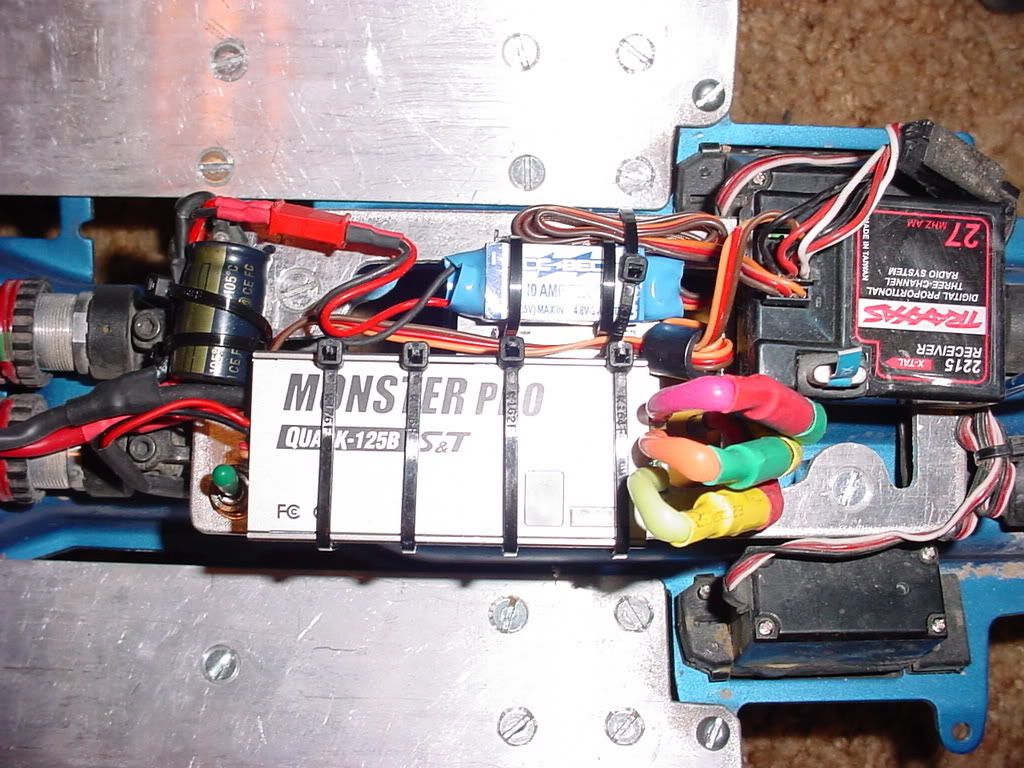
|
|
|
|
|
|
|
|
|
|
|
|
|
(#248)
|
|
|
RC-Monster Mod

Offline
Posts: 5,297
Join Date: Mar 2005
Location: SoCal
|
12.08.2007, 01:45 AM
Quote:
|
|
|
|
|
|
|
|
|
|
|
|
|
|
(#249)
|
|
Guest
Posts: n/a
|
12.08.2007, 02:03 AM
sikeston34m,
Do you have any interference problems using the 27mhz am radio gear? Very nice work too by the way. |
|
|
|
|
|
|
|
|
|
|
|
|
(#250)
|
|
|
RC-Monster Brushless
Offline
Posts: 2,085
Join Date: Sep 2007
|
12.08.2007, 11:14 AM
Quote:
Thanks Desmo. No Interference Problems at all so far. |
|
|
|
|
|
|
|
|
|
|
|
|
|
(#251)
|
|
|
RC-Monster Brushless
Offline
Posts: 2,085
Join Date: Sep 2007
|
12.08.2007, 11:16 AM
Quote:
Your probably onto something there. I'll have to take a closer look at that. I was checking it over last night, thought I had a bad wheel bearing. There was alot of slop there. It turned out to be slop in the upper/lower ball joints. They all needed readjusted. All of the slop is gone now.
|
|
|
|
|
|
|
|
|
|
|
|
|
|
(#252)
|
|
RC-Monster Brushless
Offline
Posts: 2,085
Join Date: Sep 2007
|
12.08.2007, 01:12 PM
This Post is mainly directed at JohnRob since we are both working on doing custom motor winds, so bear with me.
After winding a few stator poles with 4 strands of 22awg @ 5 turns on the 3530, I see this is gonna be tough. It's hard to get it in there and make everything lay neat. Each strand has to behave and lay parallel without crossing any of it's "neighbors". I think I see now why the person behind the PowerCroco site is going with just one strand. Even though it's stiffer, it should be easier to make lay in the turns and easier to manage. In researching, I have constantly seen references to copper density, wind resistence, and the effects of not having good values as being "copper losses" Copper Losses result in a motor that runs hotter than normal and one that is less efficient. To Minimize copper losses, one should have the most amount of copper on each stator pole looking at the Total Cross Sectional Area of the winding. In other words, each stator pole must be as full as possible AND have the least amount of resistence in the wind as possible. I'm going to try to wind with just one strand to hopefully gain some on this. I'm willing to put out the extra work and effort to do the wind and am not too worried about it "being easy on my fingers" LOL In order to know what awg of wire to use, first some things must be calculated. By taking the Cross Sectional Area of a given awg of wire, then multiplying by the number of strands used in an already succesful motor, we should be able to come up with a single strand that is the same as using all those multiple strands. CSA walks hand in hand with wire resistence also. Here is a chart that was pulled from the net that shows data for various wire sizes used in motor winding. http://www.powerstream.com/Wire_Size.htm 30awg Dia. .01(.254mm) Ohms per 1000' 103.2 max. amps .86 Cross Sectional Area = .0000785 28awg Dia. .0113(.287mm) Ohms per 1000' 64.9 max. amps 1.4 CSA = .00010023665 x 20 = .002004733 20 strands @ 5 turns = .010023665 Total CSA 26awg Dia. .0159(.403mm) Ohms per 1000' 40.81 max. amps 2.2 24awg Dia. .0201(.510mm) Ohms per 1000' 25.67 max. amps 3.5 22awg Dia. .0254(.645mm) Ohms per 1000' 16.14 max. amps 7 Cross Sectional Area = .0005064506 20awg Dia. .032(.812mm) Ohms per 1000' 10.15 max. amps 11 18awg Dia. .040(1.02mm) Ohms per 1000' 6.38 max. amps 16 16awg Dia. .050(1.29mm) Ohms per 1000' 4.01 max. amps 22 CSA = .0019625 14awg Dia. .064(1.62mm) Ohms per 1000' 2.52 max. amps 32 CSA = .00321536 12awg Dia. .080(2.05mm) Ohms per 1000' 1.58 max. amps 41 10awg Dia. .101(2.58mm) Ohms per 1000' .99 max. amps 55 Area = (pi) x r2 In English, this formula means "area equals pi times the radius squared." A circle's radius is one half of its diameter, or one half of what you get if you measure all the way across its widest part. "Squaring" something means you multiply it by itself. Pi is a number that roughly equals 3.14159. A = 3.14 x Radius x Radius Radius = Diameter/2 I have been figuring and adding Cross Sectional Area values to the chart. The 3530 motor was wound using 20 strands of 28awg wire. This is a .002004733 Cross Sectional Area of Copper. 14awg wire has a CSA of .00321536 16awg wire has a CSA of .0019625 16awg is ever so slightly less, with 14awg being about 1.5 times that. I'm going to order some more wire. Copper Density and efficiency can be improved if 14awg will fit. But even if 16awg is used, it will duplicate the density/efficiency scores that are on the market now.
|
|
|
|
|
|
|
|
|
|
|
|
|
(#253)
|
|
RC-Monster Aluminum
Offline
Posts: 905
Join Date: Aug 2007
|
12.08.2007, 03:02 PM
Give the 16awg a shot, it should be a lot easier. Are you using any winding tools? I whittled two chopsticks flat for smashing and pushing the winds in, then I have two flat sticks that keep the winds tight while I move around to the other side. The ends aren't as important as the fill between the slots.
Got any data on the CSA of 5 strands of 22awg? My figure shows .002531153, which is still less than 14awg. Looks like we need to find some 15.5 or 15awg wire. |
|
|
|
|
|
|
|
|
|
|
|
|
(#254)
|
|
|
RC-Monster Brushless
Offline
Posts: 2,085
Join Date: Sep 2007
|
12.08.2007, 10:25 PM
Quote:
Something I've noticed about making the decision on just how large the wire can be, We need two wires to lay side by side in the lower valley of the poles. Like the Scorpion 3032 that the Croco guy wound. While reading the website through a German translator, he calls it an 8wd with 1.0mm wire. According to him, This is a 550kv wind, but tests from person to person are inconsistent. This test was probably done with a working load of who knows what. 1mm wire is 18awg. Take a close look at this picture. If too large a wire is used, the bending radius won't be tight enough at the ends either. 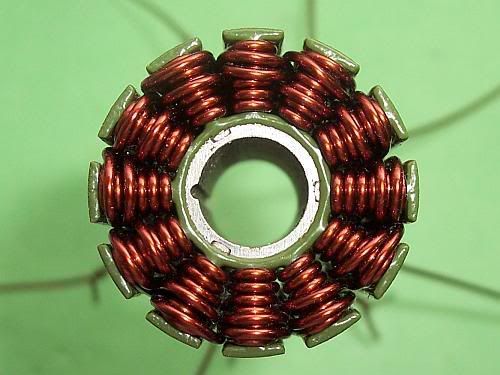 Each size of stator is different with how much of what size wire will fit. I'm really thinking about getting another AXI 4120 motor to rewind. The more I think about the custom 4130, the more I feel like I'm going to have a motor that is going to draw so many amps, the Quark 125amp Monster Pro won't even be enough on 4S Lipo. Aside from this, trying to figure how many kv it will be is a guess at best, since there isn't a 600kv to 700kv currently on the market to compare this to. I think the amp draw would be out the roof, so would performance, but this is why motor builders move up to High Voltage to get more performance. It's all about keeping the amp draw manageable. Top speed is great with the 4120/14 on 4S. Being 660kv, it's much easier to come up with a wye wind that will be the same kv and draw close to the same amperage. "Got any data on the CSA of 5 strands of 22awg? My figure shows .002531153, which is still less than 14awg." I quickly figured the Single Strand CSA of the current Scorpion offerings for the 3032. Check this out. 3032-8 988kv 27 strand 8 turn 30 awg .0000785 x 27 = Single Strand CSA = .0021195 Total CSA is .0021195 x 8 = .016956 3032-10 823kv 24 strand 10 turn 30 awg .0000785 x 24 = Single Strand CSA = .001884 Total CSA is .001884 x 10 = .01884 3032-12 687kv 20 strand 12 turn 30 awg .0000785 x 20 = Single Strand CSA = .00157 Total CSA is .00157 x 12 = .01884 5 Strands of 22awg is a CSA of .002532253 4 Strands of 22awg is a CSA of .0020258024 It's easy to figure Total Cross Section Area. Single Strand CSA x Number of turns = Total CSA The Greater the Total CSA, the higher the amp carrying ability, the more power it will make AND the more efficient the motor will be. With the 3032, shoot for a Total CSA of .01884 or better. The German guy's Croco motor wound with 18awg has a Total CSA of .010048 This tells me the Scorpion Factory winds are more efficient and make more power than the Croco motor. I think I will get some short samples of each awg wire and see how many strands of what will fit the best and work the best according to the figures. The 4120 winding should be easy enough to convert to a 660kv Wye wind and should tell us what we want to know. I think I'll shoot for that.
|
|
|
|
|
|
|
|
|
|
|
|
|
|
(#255)
|
|
RC-Monster Aluminum
Offline
Posts: 905
Join Date: Aug 2007
|
12.09.2007, 04:35 AM
It IS very difficult to determine what the KV will be before winding, although basing it from similar sized stators and magnet strengths does help. The hardest part is that every stator fill is different. I don't think I can have any more wire pushed into my stator, the 5 strands of 22awg is such a tight fit I have to thread some of the last winds in.
I kinda eyeballed the fit of my wire. Put in a chunk of strands and said "that looks enough". My math was that 40 strands would barely fit. |
|
|
|
|
|
|
 |
«
Previous Thread
|
Next Thread
»
| Currently Active Users Viewing This Thread: 1 (0 members and 1 guests) | |
 Linear Mode

|
|

Powered by vBulletin® Version 3.8.11
Copyright ©2000 - 2026, vBulletin Solutions Inc.
vBulletin Skin developed by: vBStyles.com
Copyright ©2000 - 2026, vBulletin Solutions Inc.
vBulletin Skin developed by: vBStyles.com
