
 |
|
|
|
|
|
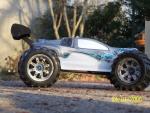
 |


 |
1/16 Mini E-Revo - Top Speed Build |
 |

|
 |

|
(#1)
|
|
RC-Monster Carbon Fiber
Offline
Posts: 175
Join Date: Jun 2009
Location: Murrieta, CA
|
1/16 Mini E-Revo - Top Speed Build -
10.01.2009, 01:34 AM
Some of you may remember I have been wandering around here lately asking a lot of questions related to brushless motors and getting the most speed from my 1/16 Mini E-Revo. I had upgraded the stock ESC and motor to an EZRun 60A and Neu 1112/2D. This worked fairly well and got me up to 73 MPH. The truck felt pretty unstable at those speeds and I had to strap about 100+ grams of weight to the nose to keep it down. My next step was to go to a larger motor. Like many others, I bought the Tenbol big block mount. While the part seems nice and is very easy to install, I was unhappy with how high the motor sat and still had clearance issues with the motor I chose. At this point I decided to pursue a custom chassis. I wanted more space for a large motor and larger batteries. I also wanted a longer wheelbase for stability and to minimize wheelies.
I wanted to do a top-notch job and decided trying to cut the chassis out with the tools I had was not going to yield the results I was looking for. I downloaded a free CAD software package and taught myself how to use it  . This is the first time I have done something like this, so I took careful measurements of the stock chassis, especially all the mounting hole locations. I then started designing the new chassis in the CAD software. I knew I wanted the wheelbase to be extended 40mm, all between the motor and the rear diff. I just designed what I thought would work well. I printed the design out on paper as I went, so I could see a scale representation of how things would fit. I made multiple revisions before I was happy. The final piece was to send the CAD files off to a place to have them cut on a waterjet. I chose 1/8" 6061-T6 aluminum for the material. In hindsight, this is overkill and I could have gone a bit thinner. . This is the first time I have done something like this, so I took careful measurements of the stock chassis, especially all the mounting hole locations. I then started designing the new chassis in the CAD software. I knew I wanted the wheelbase to be extended 40mm, all between the motor and the rear diff. I just designed what I thought would work well. I printed the design out on paper as I went, so I could see a scale representation of how things would fit. I made multiple revisions before I was happy. The final piece was to send the CAD files off to a place to have them cut on a waterjet. I chose 1/8" 6061-T6 aluminum for the material. In hindsight, this is overkill and I could have gone a bit thinner.Here are the chassis plates after I received them from the waterjet. I did have to make a few small adjustments manually for things I overlooked. All the bolt holes lined up perfectly, but there were a few areas that needed additional clearance around the tranny and driveshafts. I also did all the countersinking for the bolts. I also did the front chassis "kick-up" and rear "kick-down" with an inexpensive vise metal break I bought.  The top and bottom chassis plates are connected using M3 screws and aluminum threaded standoffs. I am using 20mm standoffs, but can run anything from 15mm to 25+mm, depending on how much battery space I need. Only a couple of the top screws are installed in these photos.    More to come.... |
|
|

|
 |
 |
 |
|
|
|
|
|
|
(#2)
|
|
RC-Monster Carbon Fiber
Offline
Posts: 175
Join Date: Jun 2009
Location: Murrieta, CA
|
10.01.2009, 01:47 AM
Next up was a motor mount. The Tenbol mount was way too high for me, especially now that I had a longer chassis and rear shock interference was not an issue. I designed this mount to be strong and as low as possible. This was not done in CAD or cut on a waterjet. This part was all manual (drill press, hacksaw, files, etc.)
Here we have the transmission plate, motor plate, and a rear brace, all 1/8" 6061-T6 aluminum.  Here are the parts assembled on the chassis. The rear brace was put there so that the pivoting motor plate is in a "double shear" connection. It also takes all of the load off of the transmission case that normally is presented by the weight of the motor.     The Mini Revo rear transmission mounts are below the top of the chassis, so I had to make these little mounting tabs that bolt to the chassis and hold the rear of the transmission.  More to come... |
|
|
|
|
|
|
|
|
|
|
|
|
(#3)
|
|
RC-Monster Carbon Fiber
Offline
Posts: 175
Join Date: Jun 2009
Location: Murrieta, CA
|
10.01.2009, 01:59 AM
The next pics are the rolling chassis. The front and rear diffs bolted in with no issues. The "arms" of the bulkheads that reach towards the middle of the truck needed to have small spacers between them and the underside of the chassis. I made small blocks of aluminum to serve as mounts/spacers for the shocks. The servo dropped straight in. You can't see it in the pics, but I made a thin sheetmetal cover for the top of the rear diff. In earlier pictures, you could see the chassis had to be cut out to clear the rear ring gear. This left it exposed, so I made the thin cover to bolt to the top of the chassis to seal it up. I used standoffs to move the rear body mounts forward some. Everything else is stock Mini Revo stuff. I was able to pull the front and rear suspension/differential assemblies from my stock truck and bolt them right on to this chassis.
 The Tekno Neu 1512/2D/F mounted up.    As you can see, there is plenty of motor space now. In fact, this chassis can accomodate a motor up to 3.3 (84mm) in length. So, I guess anything up to a Neu 1521 should bolt up to it. 
|
|
|
|
|
|
|
|
|
|
|
|
|
(#4)
|
|
RC-Monster Mod

Offline
Posts: 5,297
Join Date: Mar 2005
Location: SoCal
|
10.01.2009, 02:01 AM
Wow, nice work! This is one of the first truly inspiring things I have seen done with the 1/16 platform, since it's along the lines of something I'd do
 When all's said and done, that thing should be a tank... at least the chassis won't break 
|
|
|
|
|
|
|
|
|
|
|
|
|
(#5)
|
|
RC-Monster Carbon Fiber
Offline
Posts: 175
Join Date: Jun 2009
Location: Murrieta, CA
|
10.01.2009, 02:07 AM
Due to the extended chassis and the location of the standoffs, my battery "compartments" are 142mm long and 44mm wide. The height of the compartments is determined by the length of the standoffs used to seperate the chassis plates, in this case 20mm. I chose these batteries, Zippy Rhino 3S 2550mah 40C/50C.
 I made covers that bolt onto the chassis to hold the batteries in place securely and provide a bunch of surface area to mount electronics to. They are made from thin aluminum sheetmetal and weight pretty much nothing.    Almost done 
|
|
|
|
|
|
|
|
|
|
|
|
|
(#6)
|
|
RC-Monster Carbon Fiber
Offline
Posts: 175
Join Date: Jun 2009
Location: Murrieta, CA
|
10.01.2009, 02:13 AM
OK, so here are some pics that get you caught up to the current state of things. I'm using a Pro-Line Slipstream body that I did some creative trimming on. The idea is to keep it aerodynamic. Not really sure if I achieved that, but it looks cool. The suspension is "tied down" to keep the chassis low. There is still another 1/2" to 3/4" of travel left.
With HPI Super Nitro belted slicks on Super Star wheels...   Here are a few with some custom made foams on stock wheels...   
|
|
|
|
|
|
|
|
As for the weight... |
|
|
|
|
|
(#7)
|
|
RC-Monster Carbon Fiber
Offline
Posts: 175
Join Date: Jun 2009
Location: Murrieta, CA
|
As for the weight... -
10.01.2009, 02:21 AM
I weighed things as I went through this build. My friend's bone stock Mini E-Revo is sitting here and it weighs 2.95 pounds with 2 stock nimh battery packs. The completed truck in the pics above weighs 3.95 pounds with the big packs pictured, a Ko Propo receiver and EZRUN ESC installed. I will not be using the EZRUN, but itis all I had to get the weight. So, it is 1 pound heavier. The vast majority of that weight is the batteries and motor though. The chassis itself is only 100 grams (3.5 ounces) heavier than the stock chassis/receiver box/skidplate combo. If I were to go to thinner metal (likely 0.100") I could shave another 2 ounces or so. I'm hoping the weight won't be too much of an issue for top speed with the powerplant I am running.
BTW, the ESC I plan to run is the Mamba Max Pro that I am waiting on. I'll be running it on 6S. Another thing you cannot see in the pics. I have made a flat spot on the tranny input shaft. I am using an RCM 4mm/5mm sleeve to run a pinion gear on there. So, I will be running pinion gears on the motor and the tranny. This was the only way I was able to get the gearing options I want in the space provided. I have tested this pinion-on-pinion arrangement in a stock chassis and it seems to work OK. Not sure if it will present any issues or not. Opinions on that? |
|
|
|
|
|
|
|
|
|
|
|
|
(#8)
|
|
|
RC-Monster Carbon Fiber
Offline
Posts: 175
Join Date: Jun 2009
Location: Murrieta, CA
|
10.01.2009, 02:25 AM
Quote:
|
|
|
|
|

|
|
|
|
|
|
|
|
|
(#9)
|
|
RC-Monster Carbon Fiber
Offline
Posts: 175
Join Date: Jun 2009
Location: Murrieta, CA
|
10.01.2009, 02:28 AM
A couple more points I just remembered...
Yes, I have Traxxas CVD's on the rear and stock plastic sliders on the front. I split one of the front drive cups and don't feel like dropping $55 on a whole set of CVDs to get that one part right now. The rear-center driveshaft is made from multiple stock shafts that were combined and glued. One of the joints was left free to plunge like the stock one. I saw this trick here at RCM on an EMaxx I believe 
|
|
|
|
|
|
|
|
|
|
|
|
|
(#10)
|
|
RC-Monster Carbon Fiber

Offline
Posts: 178
Join Date: Apr 2009
Location: NorCal
|
10.01.2009, 02:43 AM
Lookin good Kazuaki! Cant wait to see this one rip! I spoke with Jenny at Castle today and they're finally sending me back my MM. She said they should be shipping out to the distributors by the end of next week or the week after =)
SCTE 1512 XXX-S VTA DX3R |
 |
|
|
|
|
|
|
|
|
|
|
(#11)
|
|
RC-Unobtainium

Offline
Posts: 1,032
Join Date: Jul 2008
Location: Sydney
|
10.01.2009, 04:17 AM
I like it! It's an inspired build
Can I suggest loosing the rear wing & making/purchasing something with almost zero downforce but with vertical stabilizers...& maybe a splitter with a little downforce at the front Losi 8ight-T |
|
|
|
|
|
|
|
|
|
|
|
|
(#12)
|
|
RC-Monster Titanium
Offline
Posts: 1,419
Join Date: Dec 2008
Location: Louisville, KY
|
10.01.2009, 08:28 AM
WOW thats awesome! How are the diffs gonna take the news?
|
|
|
|
|
|
|
|
|
|
|
|
|
(#13)
|
|
|
RC-Monster Carbon Fiber
Offline
Posts: 175
Join Date: Jun 2009
Location: Murrieta, CA
|
10.01.2009, 09:15 AM
Quote:
|
|
|
|
|
|
|
|
|
|
|
|
|
|
(#14)
|
|
|
RC-Monster Carbon Fiber
Offline
Posts: 175
Join Date: Jun 2009
Location: Murrieta, CA
|
10.01.2009, 09:17 AM
Quote:
I just received an aluminum tranny case with hardened steel gears from Hot Racing. I have not installed it yet as I want to see how the stock one will last. |
|
|
|
|
|
|
|
|
|
|
|
|
|
(#15)
|
|
RC-Monster Dual Brushless

Offline
Posts: 5,139
Join Date: Sep 2006
|
10.01.2009, 09:23 AM
Looking good. You could try to add a little lip to the front of the body for some downforce. How fast can you remove the batteries?
|
 |
|
|
|
|
 |
«
Previous Thread
|
Next Thread
»
| Currently Active Users Viewing This Thread: 1 (0 members and 1 guests) | |
 Linear Mode

|
|

Powered by vBulletin® Version 3.8.11
Copyright ©2000 - 2026, vBulletin Solutions Inc.
vBulletin Skin developed by: vBStyles.com
Copyright ©2000 - 2026, vBulletin Solutions Inc.
vBulletin Skin developed by: vBStyles.com
