
 |
|
|
|
|
|
 |


 |
Regen Braking Calculation? |
 |

|
 |

|
(#1)
|
|
RC-Monster Admin

Offline
Posts: 14,609
Join Date: Nov 2005
Location: Des Moines, IA
|
Regen Braking Calculation? -
03.24.2011, 03:43 PM
I am putting this in the CC forum because this is the most likely place that a CC rep may post a technical response.
We all know regen braking is used in our ESCs (well, most people know this, some just don't accept it - you know who you are). And we can presumably figure out the amount of kinetic energy a moving vehicle has using its speed, weight, and time to stop ((mass*speed^2)/time to stop). And we know braking efficiency (~35% ?) is not as high as during normal running. But, is there a way to calculate if and how much actual battery charging is taking place? Obviously, the voltage induced by braking has to exceed the battery voltage for regen charging to occur. Can we determine what that voltage is? And, am I to assume that if the induced voltage is NOT higher than the battery voltage that the energy is not being used to charge the battery, but is simply being absorbed by the motor/ESC (which would explain why motor braking makes components warmer)? And then, am I correct when I say that the charge current is determined by the difference between the induced voltage and battery voltage, divided by various resistances (the output "impedance" of the motor, ESC copper, FETs, wiring, battery internal R, etc). Some of these can be assumed, some I have no idea. Just curious. 
|
  |

|
 |
 |
 |
|
|
|
|
|
|
(#2)
|
|
RC-Monster Aluminum
Offline
Posts: 610
Join Date: Feb 2009
Location: Tomball/ Houston Tx.
|
03.24.2011, 04:11 PM
Awsome, I have been racking my feeble little mind to figure out how the brakes work when the motor isn't spinning very fast.
Jeff |
|
|
|
|
|
|
|
|
|
|
|
|
(#3)
|
|
RC-Monster Admin
Offline
Posts: 14,609
Join Date: Nov 2005
Location: Des Moines, IA
|
03.24.2011, 04:24 PM
Well, you know that brakes work by shorting the motor phases in pulses. When the motor isn't spinning fast, or you brake gently, it will still slow the vehicle down but there isn't enough induced voltage to overcome the reduced braking efficiency and exceed the battery voltage, so no "charging" occurs. When this happens I believe the motor and ESC just absorbs the energy. At least this is how I think it works.
|
|
|
|
|
|
|
|
|
|
|
|
|
(#4)
|
|
2 KiloWatt RACER
Offline
Posts: 2,496
Join Date: May 2007
Location: Houston
|
03.24.2011, 04:30 PM
Well my brain is smaller than Jeffs, but my datalogs do show current during braking. And since this the logger is in series, than that tells me that there is current flowing back during hard braking. The thing is though that I also add capacitors to my ESC's to cool the sucker down and "smooth" out my hard brakes. I don't have any saved datalogs with the before and after results with the caps installed. So I can't say/tell if the back current is higher or not when I use my brakes with the caps installed.
Jeff I guess we will need to meet up and use my 50hz logger to see the brakes graphs during wimpy and manly stops. GTP-Pletty Big Maxximum+RX8. GTP-C50-6L Hacker+RX8. CRT.5-Pro4+ZTW esc. 24s2p EVG SX 49.6mph Ebike. 18s4p Raptor 60mph Ebike. 11.5KW |
|
|
|
|
|
|
|
|
|
|
|
|
(#5)
|
|
|
2 KiloWatt RACER
Offline
Posts: 2,496
Join Date: May 2007
Location: Houston
|
03.24.2011, 04:34 PM
Quote:
GTP-Pletty Big Maxximum+RX8. GTP-C50-6L Hacker+RX8. CRT.5-Pro4+ZTW esc. 24s2p EVG SX 49.6mph Ebike. 18s4p Raptor 60mph Ebike. 11.5KW |
|
|
|
|

|
|
|
|
|
|
|
|
|
(#6)
|
|
Guest
Posts: n/a
|
03.24.2011, 05:18 PM
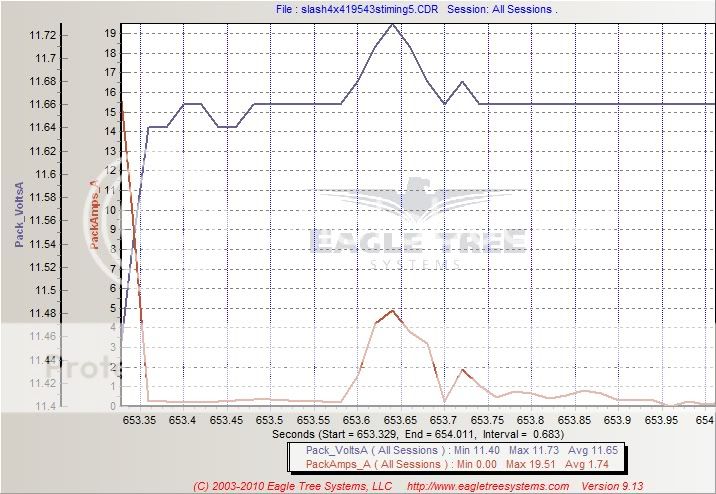
Since I had my datalogger on anyways, I decided to purposely show a good brake spike. This is with my 1415 in my Slash 4x4. I just added a cap to my SV2, and can't say it really appears to of changed anything.
|
|
|
|
|
|
|
|
|
|
|
|
|
(#7)
|
|
Guest
Posts: n/a
|
03.24.2011, 05:26 PM
Hello
I tried to play in this regard. Theme here, use the translator http://forum.rcdesign.ru/f71/thread222017.html Already decided the following, the power released during braking is not small. Used as a DC / DC converter based on LT1270 On the hand other chips such power was not (8A) Logs are at the link above and / or http://photofile.ru/users/berserk80/96567697/ |
|
|
|
|
|
|
|
|
|
|
|
|
(#8)
|
|
RC-Monster Aluminum
Offline
Posts: 610
Join Date: Feb 2009
Location: Tomball/ Houston Tx.
|
03.24.2011, 06:04 PM
Romano my head may be bigger, but I doubt my brain is, it’s called Homer Simpson Syndrome.
Brian I understand how shorting the phases would cause the braking action. If fact this is how I thought the system worked until Patrick said otherwise. On my old Brushed Streak ESC there was a lone Fet that was across the motor terminals that would do the braking function. But on the brushless system since the Fets are arranged in an H bridge configuration you can pretty much do whatever you want through programming on the ESC. I am guessing that what has to happen is that if the motor back EMF is greater than battery voltage then you commutate the phases until the voltage drops below that value then switch to just shorting the windings until the car comes to rest, or does is there a way to shove the current through the bridge even though the voltage is not high enough? I have to admit that I was pretty shocked that when I tested by strapping my meter to my rustler that I even got a .5V increase since the Kv for the motor I was using is near 6K and I was using such a low voltage pack, and the brakes lock up so easily on it. I was only able to get this result after running it to top speed and applying the brakes as hard as I could without locking them up. Later when I tried it again I couldn’t get much of a result, mostly because the voltage of the pack would rise when it was at rest. This was the reason I didn’t use a fresh of the charger pack since the voltage would constantly drop. Jeff |
|
|
|
|
|
|
|
|
|
|
|
|
(#9)
|
|
RC-Monster Admin
Offline
Posts: 14,609
Join Date: Nov 2005
Location: Des Moines, IA
|
03.24.2011, 06:16 PM
Actually, if I read Patrick's explanation correctly, the FETs do short the motor phases (in PWM form). While the FET shorts the phase, the motor wants to stop, but since the braking is done in PWM pulses, the overall effect is more gradual. The only time voltage is "sent back" to the battery is when the FETs go from shorted to open. At this time, the motor is allowed to free run again, and this is when some of that stored energy is allowed to go back to the battery.
|
|
|
|
|
|
|
|
|
|
|
|
|
(#10)
|
|
2 KiloWatt RACER
Offline
Posts: 2,496
Join Date: May 2007
Location: Houston
|
03.24.2011, 06:26 PM
So what happens when the brakes lock the motor?
What does it take for a sensorless setup to have ABS brakes? GTP-Pletty Big Maxximum+RX8. GTP-C50-6L Hacker+RX8. CRT.5-Pro4+ZTW esc. 24s2p EVG SX 49.6mph Ebike. 18s4p Raptor 60mph Ebike. 11.5KW |
|
|
|
|
|
|
|
|
|
|
|
|
(#11)
|
|
RC-Monster Admin
Offline
Posts: 14,609
Join Date: Nov 2005
Location: Des Moines, IA
|
03.24.2011, 06:31 PM
When the brakes lock the motor, there is no regen at all. The tires/ground are absorbing the energy and the ESC and motor aren't wasting any power (maybe still a tiny bit).
I would imagine the ABS function is probably done via clever programming. |
|
|
|
|
|
|
|
|
|
|
|
|
(#12)
|
|
2 KiloWatt RACER
Offline
Posts: 2,496
Join Date: May 2007
Location: Houston
|
03.24.2011, 06:45 PM
Doesn't it take power to lock a brushless motor in a 8lbs moving vehicle? I mean when I short all the motor wires together, the rotor is harder to turn. But it's still doable. So it should take some energy to lock the motor. Kinda different than slowing down the motor with pwm. Maybe I need relax on the Monster Energy and just wait for more guru's to post.
GTP-Pletty Big Maxximum+RX8. GTP-C50-6L Hacker+RX8. CRT.5-Pro4+ZTW esc. 24s2p EVG SX 49.6mph Ebike. 18s4p Raptor 60mph Ebike. 11.5KW |
|
|
|
|
|
|
|
|
|
|
|
|
(#13)
|
|
RC-Monster Admin
Offline
Posts: 14,609
Join Date: Nov 2005
Location: Des Moines, IA
|
03.24.2011, 07:07 PM
The faster the motor is spinning, the harder the braking force is when the phases are shorted. You probably were only turning them at finger speed, which will produce a lot less braking force than if a motor was spinning at even 1000rpm.
|
|
|
|
|
|
|
|
|
|
|
|
|
(#14)
|
|
2 KiloWatt RACER
Offline
Posts: 2,496
Join Date: May 2007
Location: Houston
|
03.24.2011, 07:09 PM
AAAh, got it.
At least I now know their is such a thing as finger speed. GTP-Pletty Big Maxximum+RX8. GTP-C50-6L Hacker+RX8. CRT.5-Pro4+ZTW esc. 24s2p EVG SX 49.6mph Ebike. 18s4p Raptor 60mph Ebike. 11.5KW |
|
|
|
|
|
|
|
|
|
|
|
|
(#15)
|
|
RC-Monster Aluminum
Offline
Posts: 610
Join Date: Feb 2009
Location: Tomball/ Houston Tx.
|
03.24.2011, 07:16 PM
I am not sure the rotor actually stops, it would seem that the motor is just turning so slowly that the speed of the wheels is slower than the cars ground speed, so the tires are just sliding on the surface.
I think ABS would be pretty "easy" to program, even in a sensorless setup. I think everything you would need to know is already there. Brian do you remember where that post was, it's been a while since I read it? Jeff Nevermind I found it. http://www.rc-monster.com/forum/show...0&postcount=57 |
|
|
|
|
|
|
 |
«
Previous Thread
|
Next Thread
»
| Currently Active Users Viewing This Thread: 1 (0 members and 1 guests) | |
 Linear Mode

|
|

Powered by vBulletin® Version 3.8.11
Copyright ©2000 - 2026, vBulletin Solutions Inc.
vBulletin Skin developed by: vBStyles.com
Copyright ©2000 - 2026, vBulletin Solutions Inc.
vBulletin Skin developed by: vBStyles.com
